
Home physiotherapy
Ask our physiotherapist about your symptoms
₹1000 First session ₹499

Quick Physio Blog
In Chembur I spend as much of the first visit on the bathroom threshold and the medicine box as on the joint itself. With older patients, the joint is rarely the only thing that has changed.
Home physiotherapy
₹1000 First session ₹499
A large share of the calls I take from Chembur are made by an adult child about a parent. The parent is usually in their late sixties or seventies, has lived in the same colony flat for thirty or forty years, and has had aching knees or hips for long enough that nobody remembers when it started. The trigger for the call is almost never the pain itself. It is that something functional has changed — they have stopped going down for the evening walk, or they are taking the stairs sideways, or there was an incident in the bathroom that got mentioned once and then dropped.
That changes how I run the session. With a thirty-five-year-old the question is which tissue is irritated. With a seventy-five-year-old the question is broader: what has this person stopped doing, why, and what is the actual risk of the next six months. Joint pain in an older patient sits inside a system that includes strength, balance, eyesight, footwear, blood pressure medication and the height of the bathroom threshold. Treating the knee in isolation misses most of it.
The good news is that the response to training in this age group is genuinely excellent, and consistently better than most people expect. Muscle responds to load at seventy-five. Balance improves with practice at eighty. What it needs is a programme that is honest about the starting point, safe enough to be done without supervision, and short enough that it happens every day rather than heroically once a week.
Chembur's housing stock is a big part of the clinical picture. The RCF and BARC colonies, Tilak Nagar, the Sindhi Colony lanes and the older buildings around Chembur Naka are mostly low-rise blocks from the fifties through the seventies. Ground plus three or four, no lift in many of them, and internal staircases with treads narrower than modern code would allow. For a resident with an arthritic hip on the third floor, the staircase is the single most consequential thing in their week.
The bathroom is the second. Older colony flats commonly have a step up or down into the bathroom, a floor that stays wet, and in many homes an Indian-style toilet that requires a deep squat. That squat is a full-range loaded knee and hip movement performed several times a day, and it is frequently the specific thing that becomes impossible first. When it does, people stop drinking water in the evenings to avoid getting up at night, and that produces its own set of problems.
Then there is Diamond Garden. A remarkable number of Chembur seniors have walked there most mornings for decades, and that daily walk is doing more for their knees, mood and balance than anything I will prescribe. Between June and September it stops — wet paths, the risk of a slip, family telling them not to go. Four months later the walk has not restarted, the legs are weaker, and the first attempt feels awful, which confirms the fear. Breaking that loop is often the whole treatment.
Nobody books a physiotherapist because they fell. They book because the knee hurts. The fall comes up thirty minutes into the session, usually phrased as a slip, usually reported as nothing serious, and usually more than one. I ask directly, every time, because a fall in the last twelve months is the strongest single predictor of the next one, and because it changes the priorities of the plan completely.
When somebody has fallen, strength work alone is not enough. Balance is a trainable skill with its own specific exercises, and it deteriorates faster than strength does when it is not practised. Most older patients I see in Chembur have not deliberately practised standing on one leg since childhood. Their single-leg stance time is often under five seconds, which for someone who negotiates a wet bathroom step several times a day is a number worth improving.
There is also a fear component that deserves respect rather than dismissal. Somebody who has slipped on a monsoon landing and now grips the rail with both hands has made a rational decision. The way out is not reassurance, it is competence — practising the specific movements in a safe setting until the body has evidence that it can do them. That is a different conversation from telling somebody to be careful.
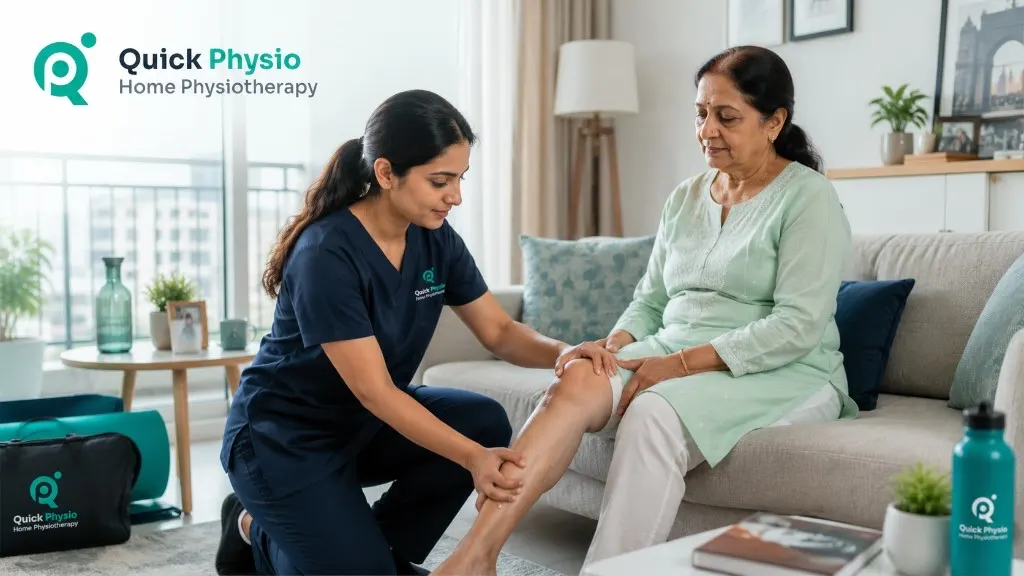
A geriatric home visit is longer on observation and shorter on hands-on than a younger patient's. The first home session is ₹799 rather than the usual ₹1600, and I use most of it walking around with you. Half the useful findings are in rooms nobody thinks to mention. The osteoarthritis guide covers the joint side of this if a family member wants background reading.
Older patients present differently and the warning signs are worth knowing by the whole household, not just by me. Some of these look minor and are not.
If any of these are present, the visit turns into an explanation and a referral. I will tell you what I think is happening and what to ask the doctor for, which is often more useful than a treatment would have been.
The best programme is the one that gets done. Three exercises, each under three minutes, each done standing at the kitchen counter or sitting in the chair that is already there. No floor work, no mat, no equipment. I attach them to existing habits — the kettle, the morning tea, the evening news — because time-based instructions fail and habit-based ones survive.
Balance and strength improve on a slower and more reliable clock than pain does. In an older patient doing the three exercises most days, I expect the sit-to-stand count and the stance times to change measurably by six to eight weeks, and the walking to feel steadier before the joint feels less painful. Twelve weeks is a fair horizon for a meaningful functional change. Nobody should be told their arthritis will be cured, and anybody who tells you that is selling something.
The other honest point is about family expectations. The adult child who called usually wants their parent restored to how they were five years ago. The realistic and genuinely valuable goal is different: getting back down to Diamond Garden, managing the staircase without turning sideways, using the bathroom without fear, and reducing the chance of a fracture. Those are worth a great deal, and they are achievable.
Quick Physio operates in Chembur as a home visit service, not a clinic, and for this group that is the entire point. An older patient with an arthritic hip should not have to descend three flights and take a rickshaw in order to be treated for difficulty descending three flights. Give the colony or building name, the floor, and whether there is a lift when you book, and please be there for the first visit if you are the family member organising it — a lot of the useful history comes from the person who noticed the change.
Frame it around a task rather than around decline. Most people who refuse treatment for their knee will agree to a visit about getting back to the morning walk, or about managing the bathroom step safely. Starting from something he wants back works far better than starting from what he has lost.
Appropriately dosed exercise is one of the safer things in medicine at that age, and the risks of not moving are considerably higher. I screen for cardiac symptoms and dizziness first, keep the intensity moderate, and if there is anything unclear about medication or blood pressure I ask the physician before progressing.
It matters a great deal. Two falls in a year substantially raises the odds of another, and the consequences escalate with age. Balance is trainable, home hazards are fixable, and the combination reduces risk. Slipping is the explanation people use because it feels less like a loss of ability.
Because hip problems very commonly refer pain to the front of the thigh and the knee, and a proportion of stubborn knee pain in older patients turns out to be a hip. Checking hip rotation takes two minutes and occasionally redirects the entire treatment plan, so it is always worth doing.
Sometimes, with a grab rail and improved leg strength. Often the better answer is a commode adapter or a raised seat, which costs little and removes several deep squats a day. I would rather save that range of movement for exercises we control than spend it on the bathroom.
For most older patients, weekly for the first three or four weeks, then fortnightly as the programme becomes independent. The aim is that the family and the patient run the exercises daily and I supervise progression, not that I come every day. More frequent visits rarely produce faster results.
Patients report it too consistently for me to dismiss it, and joint stiffness in damp weather is a common experience. What I can measure, though, is the drop in daily activity across those four months, and that accounts for most of the decline I actually see in September.
Chembur East and West, including the RCF and BARC colony areas, Tilak Nagar, Chembur Naka, Basant Park and the Anushakti Nagar side, plus Ghatkopar and Sion on the edges. Mention the floor and whether there is a working lift, as it affects how the session is set up.
Home physiotherapy
₹1600 First session ₹799
Book ₹799 home physiotherapy (metro cities) →
Clinic Google Map on Contact page →
Arthritis, balance trouble or a parent who has stopped going for the morning walk? Book a home visit — first session ₹799 instead of ₹1600, with a full mobility and home-safety assessment.
5
33 Google reviews
Patient reviews
Real Google reviews for Quick Physio Physiotherapy & Rehabilitation Center — 5★ from 33 patients.
I had a wonderful experience at this therapy centre. The therapists are highly professional, compassionate, and genuinely dedicated to helping their clients. The environment is clean, welcoming, and comfortable, makin…
I had a very good experience at QuickPhysio Clinic. The physiotherapists are highly skilled, professional, and take time to understand the patient’s condition properly. The treatment was effective, and I noticed signi…
Great experience overall. The staff was polite and supportive, and the treatment sessions were handled with care and attention. The exercises and guidance provided were easy to follow and really helped with recovery.
I had been suffering from slip disc and cervical pain for quite some time, and after taking physiotherapy sessions at this center, I experienced significant relief. The therapists are highly skilled, professional, and…
Excellent work by doctor. Having a great experience till 5 day.
Assessment-led care at home across Ghaziabad & Delhi NCR — first home session ₹499.
Browse locations Contact & map