
Home physiotherapy
Ask our physiotherapist about your symptoms
₹1000 First session ₹499
Quick Physio Blog
Navi Mumbai sends me a different patient from town. Younger, often a parent in the first two years, in a flat that is newer and wider than anything in the island city — and still hurting.
Home physiotherapy
₹1000 First session ₹499
People assume the pain problem is an old-building problem. Then I visit a four-year-old tower in Kharghar or a Seawoods society with a podium garden, a working lift, wide internal doors, and a living room you could actually exercise in — and the back pain is identical to the one I saw in a 1970s walk-up that morning. The building is not the variable. The day is.
What is genuinely different here is who is in the flat. The demographic in the newer Navi Mumbai societies skews young: couples in their late twenties and thirties, often with a child under three, frequently with both parents working and no grandparent living in. That combination produces a very specific load profile, and it is not the one the internet writes about when it writes about office posture.
It also changes what the flat is used for. There is space, but the space is occupied by a cot, a walker, a drying rack in monsoon, and a dining table that has become somebody's desk. When I plan exercises here, I am planning around a sleeping baby and a shared room, not around whether there is enough floor.
The commuters who take the Harbour line from Vashi, Nerul or Belapur into town get a long ride, and long is the operative word. An hour and ten minutes standing, with the bag on one shoulder and one arm up on the bar, is a very different tissue load from a fifteen-minute hop. By the time they reach CSMT or change at Kurla for the Central line, the mid-back has been held in one shape for most of an hour. People describe it as a band across the shoulder blades that switches on around Mankhurd.
The Palm Beach Road and Sion-Panvel Highway drivers get the opposite. Seated, warm, comfortable, and completely flexed for ninety minutes each way. The car commuters almost never describe pain during the drive. They describe it when they get out — that first twenty seconds of standing at the podium gate where the lower back does not want to straighten. That is a flexion-intolerant back telling you exactly what it has been doing.
Kharghar adds a third group: the hills. People who walk or run the Kharghar hills and the Central Park loops at weekends and do nothing at all from Monday to Friday. A single long weekend effort after five sedentary days is a classic overload pattern, and it shows up in knees, shins and Achilles tendons far more than in backs.
The single most frequent Navi Mumbai referral I get is a parent six weeks to two years after delivery, with low back or pelvic pain, and a strong belief that this is just what having a baby does to you. It is very common. It is not something you have to keep. And the mechanics are usually readable within twenty minutes of arriving.
The load is relentless and asymmetric. A toddler carried on the same hip every time, which side-bends the trunk for hours a week. A cot with a fixed-height rail, so every lift in and out is a forward bend with a load at arm's length. Feeding in a soft sofa corner with the shoulders rounded and the neck flexed for forty minutes, six or eight times a day. A pram lifted over the podium threshold. None of these are injuries. All of them are repetitions.
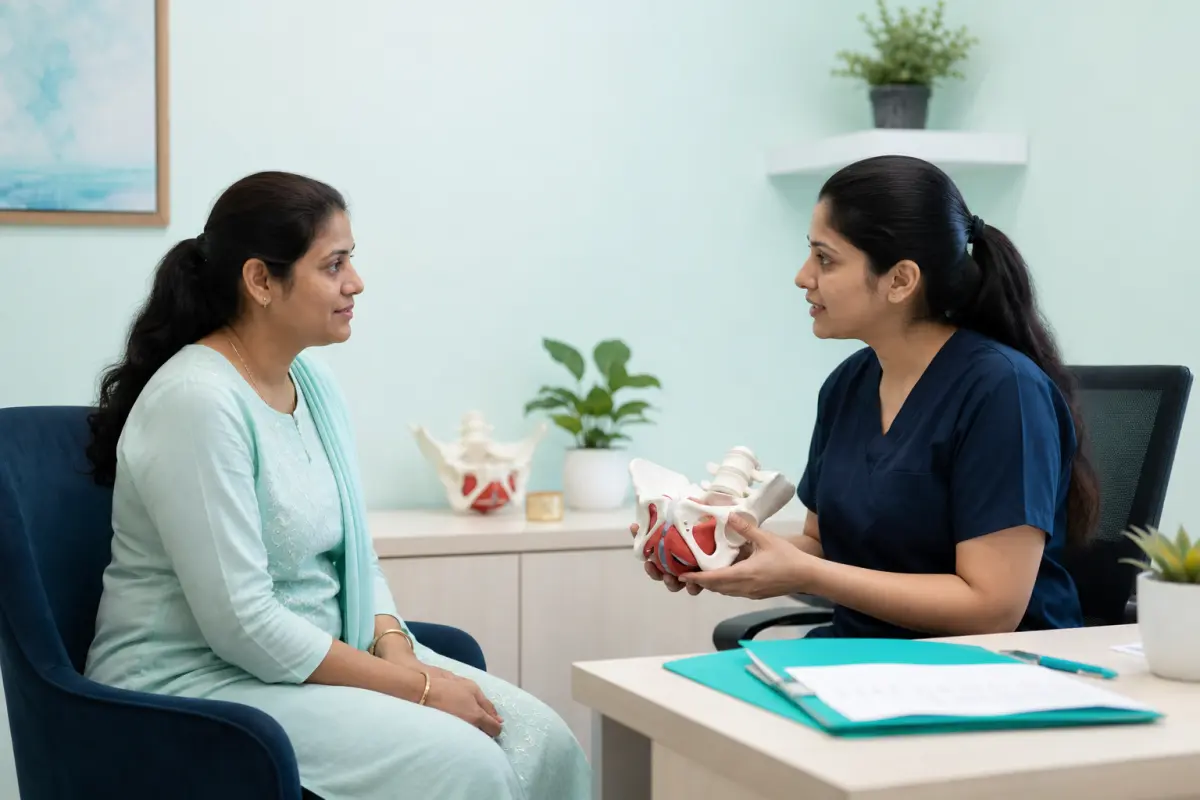
On top of that sits a genuine physiological recovery. Abdominal wall and pelvic floor function do not return automatically at six weeks just because the obstetric review said things look fine. I check for abdominal separation, for how the pelvic floor and deep abdominals respond to a breath out, and for whether the ribcage is still sitting in the flared position it adopted late in pregnancy. The pregnancy-related pain guide goes into the antenatal side of this in more detail.
The first visit is around an hour and it runs the same way whether you are the commuter or the new parent, with an extra postnatal layer where relevant. The first home session is ₹799 rather than the usual ₹1600, and I would rather spend it testing than demonstrating machines. Nothing in the list below needs equipment you do not already own.
Some presentations need a physician or obstetrician before they need a physiotherapist, and that is a decision I make in the first session rather than the fifth. The postnatal list is slightly different from the general one, so both are worth knowing.
If any of these appear, the visit becomes a conversation and a referral rather than a treatment. That is still a useful hour, and I will tell you exactly what to ask for.
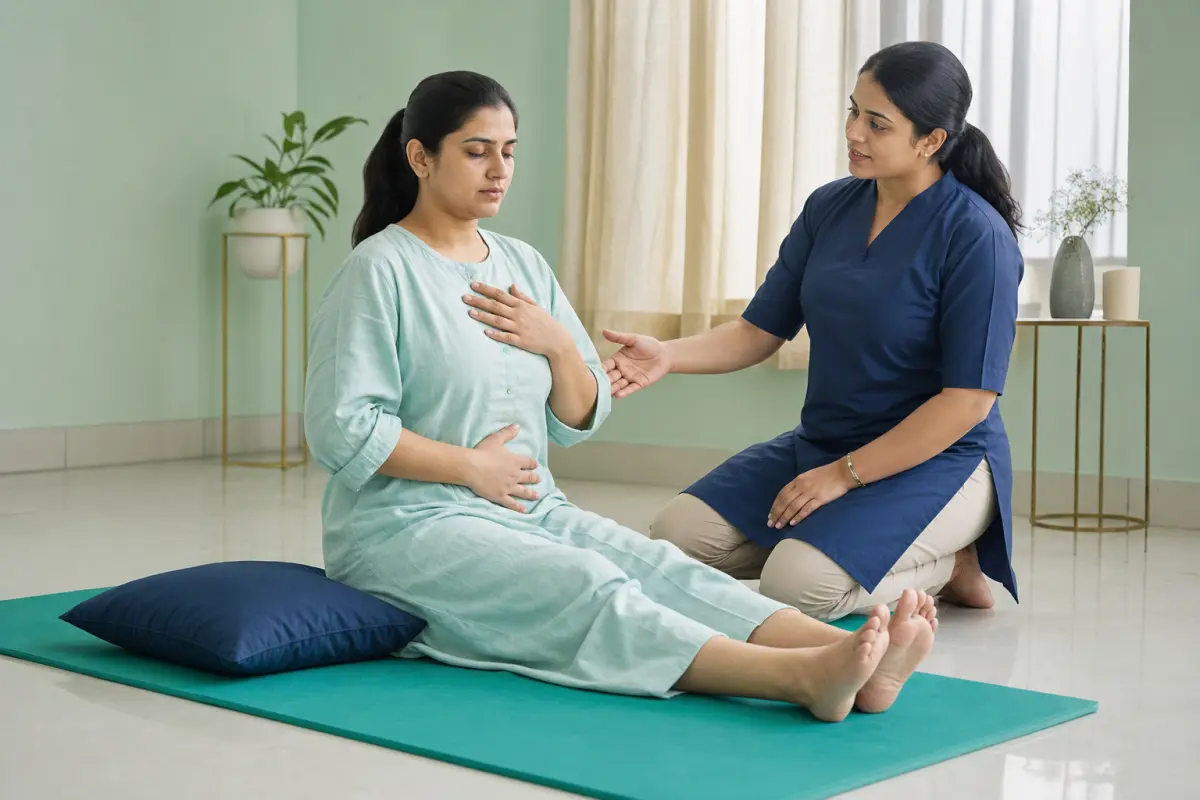
Everything here is quiet, needs no equipment, and can be done in the ten minutes that exist rather than the forty-five minutes that do not. These are the three I leave most often with Navi Mumbai parents. If you are the Harbour line commuter rather than the parent, the second and third still apply, and I would add a standing back extension every couple of hours at your desk.
Postnatal core and pelvic floor work is a twelve-week conversation, not a four-week one, and I say that at the start so nobody feels behind at week three. Abdominal separation usually narrows and, more importantly, starts generating tension across the midline over eight to twelve weeks of consistent work. Mechanical low back pain in a commuter moves faster — most people notice a genuine difference within two to three weeks and finish the first block in four to six sessions.
The logistics here are easier than in the island city and I plan around them. Navi Mumbai societies usually have visitor gate registration, so the name and phone number go in at booking. Sector and society name matter more than the postal address, since the sector grid is how everybody navigates. Evening slots across Vashi, Nerul, Sanpada, Belapur, Seawoods and Kharghar are the busiest, so booking two or three days ahead gets you the time you want.
Quick Physio does not run a clinic in Navi Mumbai — this is a home visit service across the node. For a new parent that is usually the deciding factor, because loading a baby into a car for a clinic appointment is the exact activity we are trying to make less painful. For everyone else, it means I get to see the sofa, the cot and the car seat that are doing the damage, which is worth more than a treatment table.
Gentle breathing and positioning work can start within the first couple of weeks for most people. Anything involving real load waits until after the six-week obstetric review, and longer after a caesarean. I always ask what your obstetrician has cleared before I add resistance.
Rarely, and it is almost never the first step. What matters more than the width of the gap is whether the tissue between the edges can generate tension when you load it. Most people improve that measurably over eight to twelve weeks of graded work before anyone mentions a surgeon.
Kharghar is a regular pin, along with Vashi, Sanpada, Nerul, Seawoods and Belapur. Panvel and the Ulwe side depend on the slot, so ask when you book rather than assuming. Sector and society name get you a faster answer than a pin drop.
That is a fairly classic flexion-intolerant pattern. Ninety minutes of sitting holds the lumbar spine in one flexed shape, and the tissues take a moment to tolerate the opposite direction. The fix is usually not a better car seat — it is breaking the flexion up and rebuilding extension tolerance.
Please. I write everything down and I am happy to run through it twice with whoever is in the flat. In households where one person is doing all the lifting and carrying, having a second person who knows the hip hinge pattern changes how the week actually goes.
At thirty-two, almost certainly not. Aching after a long weekend effort following five sedentary days is a loading mismatch, and the answer is usually mid-week volume rather than rest. I would still test the knee properly before assuming, because patellar and tendon problems need different handling.
One session is usually enough to tell you what is going on mechanically, whether it needs a doctor, and what to start doing. It is not usually enough to fix it. I give a session range and a review point at the end of the first visit so you can decide with real numbers.
No. The Navi Mumbai service is home visits only. For most of what I treat here that works out better, since the cot, the sofa and the car seat causing the problem are all in your flat and none of them fit in a clinic.
Home physiotherapy
₹1600 First session ₹799
Book ₹799 home physiotherapy (metro cities) →
Clinic Google Map on Contact page →
Home physiotherapy across Vashi, Nerul, Sanpada, Belapur, Seawoods and Kharghar — first home session ₹799 instead of ₹1600. Assessment in your own flat, around your own cot and car seat.
5
33 Google reviews
Patient reviews
Real Google reviews for Quick Physio Physiotherapy & Rehabilitation Center — 5★ from 33 patients.
I had a wonderful experience at this therapy centre. The therapists are highly professional, compassionate, and genuinely dedicated to helping their clients. The environment is clean, welcoming, and comfortable, makin…
I had a very good experience at QuickPhysio Clinic. The physiotherapists are highly skilled, professional, and take time to understand the patient’s condition properly. The treatment was effective, and I noticed signi…
Great experience overall. The staff was polite and supportive, and the treatment sessions were handled with care and attention. The exercises and guidance provided were easy to follow and really helped with recovery.
I had been suffering from slip disc and cervical pain for quite some time, and after taking physiotherapy sessions at this center, I experienced significant relief. The therapists are highly skilled, professional, and…
Excellent work by doctor. Having a great experience till 5 day.
Assessment-led care at home across Ghaziabad & Delhi NCR — first home session ₹499.
Browse locations Contact & map