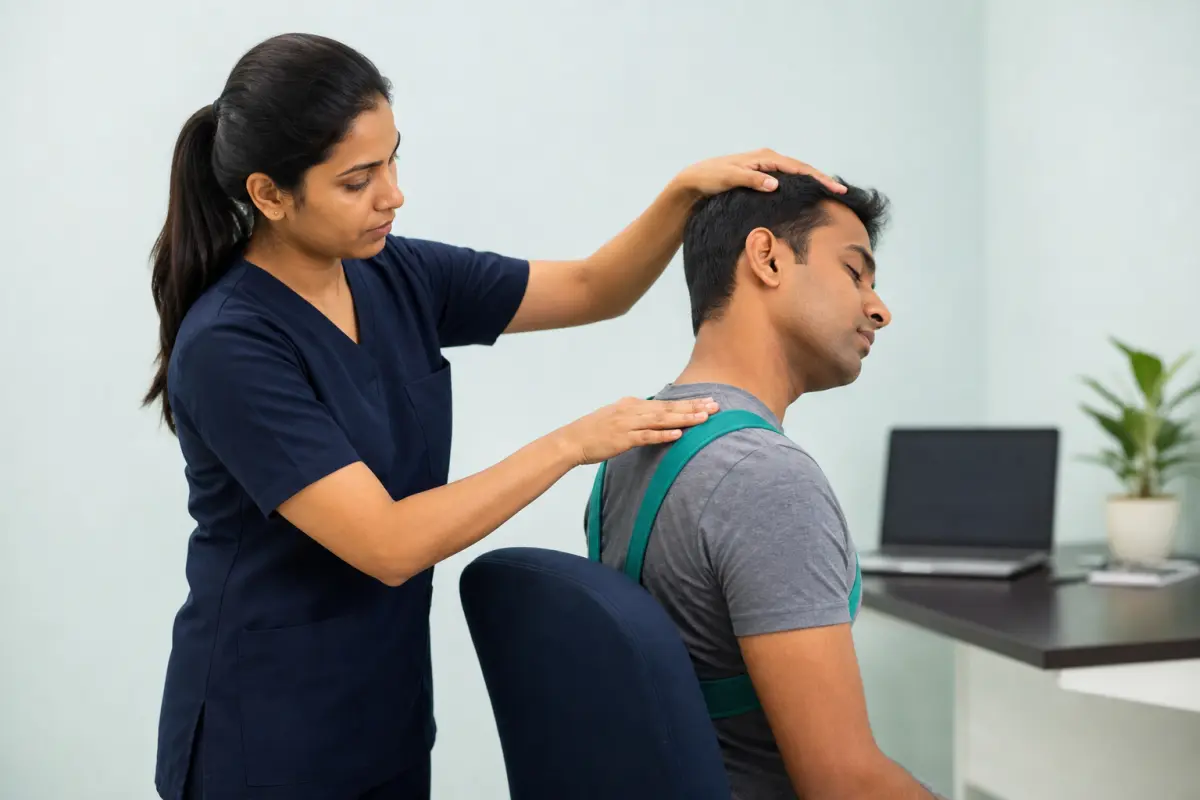



What is frozen shoulder?
Frozen shoulder (adhesive capsulitis pattern) is progressive stiffness and pain in the shoulder capsule. Reaching overhead, behind the back or out to the side becomes limited — often with night pain.
Why does this problem happen?
The shoulder capsule can become inflamed and then fibrotic, reducing available motion. It may follow a minor injury, surgery, or appear without a clear trigger. Diabetes and thyroid conditions raise risk. Forcing range aggressively often worsens irritability.

What kinds of frozen shoulder can occur?
Not every case feels the same. These are common patterns we see in clinic and home visits across Delhi NCR:
Freezing (pain-dominant) stage
Night pain and irritability lead; range starts to shrink. Aggressive stretching here often backfires — calm and protect first.
Frozen (stiffness-dominant) stage
Pain may ease slightly while dressing, grooming and overhead reach stay markedly limited — guided mobility becomes the focus.
Thawing stage
Usable range gradually returns; this is when progressive strength and functional reach tasks rebuild confidence.
Secondary stiffness after injury or surgery
Immobilisation or guarding after trauma can mimic a frozen pattern — staging still matters, with clearance from your doctor when needed.
Common causes & triggers
These are frequent reasons frozen shoulder starts or keeps returning:
- Idiopathic onset (no clear injury)
- After shoulder trauma or immobilisation
- Post-surgery stiffness
- Diabetes or metabolic factors
- Prolonged guarding after a strain
Risk factors — who is more at risk?
These factors don’t guarantee frozen shoulder, but they raise the odds and are worth addressing alongside treatment:
- Age 40–65
- Diabetes
- Recent shoulder immobilisation
- Non-dominant or dominant arm overuse after a flare

Recognise your pattern? A clear assessment is faster than guessing exercises from the internet.
Call +91 79002 56729 WhatsApp usSigns & symptoms
- Progressive loss of shoulder reach
- Night pain or sleep disturbance
- Difficulty with dressing or grooming
- Pain at end-range movement
Shrinking overhead reach
Putting a shirt on or reaching a high shelf becomes month-by-month harder — progressive loss of elevation is a hallmark.
Night pain that wakes you
Lying on the affected side or rolling in bed often disturbs sleep in the freezing phase more than daytime tasks do.
Difficulty reaching behind the back
Internal rotation for bra straps, belts or hygiene is commonly one of the last and most frustrating losses.
External rotation lag
Turning the forearm out with the elbow at the side feels blocked — a key clinical finding distinguishing capsule stiffness from simple muscle strain.
End-range catch of pain
Movement feels tolerable mid-range then sharp at the limit — we work inside a calmer window rather than forcing past it.
Compensatory shoulder hiking
The upper trap shrugs to fake reach; this protects short-term but keeps the capsule from getting honest, guided motion.
When should you see a physiotherapist?
Early assessment helps. If range keeps shrinking or night pain dominates, don’t wait for it to “thaw” alone — especially with diabetes history, discuss with your doctor and physio.
Seek urgent medical attention for bowel/bladder changes, rapidly worsening weakness, unexplained weight loss, fever, or symptoms following major trauma — these are emergency signs, not routine physiotherapy concerns.
How physiotherapy helps
We respect irritable phases, use appropriate mobilisation and isometrics, then rebuild strength as motion returns — no aggressive forcing.
- Stage-matched care: Pain-dominant and stiffness-dominant phases need different doses of stretch and load — forcing the wrong phase slows progress.
- Protect sleep and daily function: Positioning, pacing and temporary task edits reduce night flares so you can tolerate daytime rehab.
- Guided mobility gains: Pendulum, wall walks and assisted stretches expand usable range without aggressive end-range forcing.
- Isometrics then strength: Early gentle holds maintain muscle; as motion returns we rebuild rotator cuff and scapular capacity for real reach tasks.
- Dressing and grooming practice: Rehab targets the movements you miss most — sleeves, hair care, seatbelts — not only clinic measurements.
- Medical liaison when needed: If your doctor discusses injection or further imaging, we coordinate so physiotherapy continues alongside that plan.
Treatments we may use for frozen shoulder
Based on your assessment, your plan may include one or more of these physiotherapy treatments:



Treatments we offer for frozen shoulder
Quick Physio does not run a one-modality clinic. After assessment, your plan for frozen shoulder may combine several of these treatments — chosen for your irritability, goals and whether you are seen at home or in our Ghaziabad clinics.
Manual Therapy
For frozen shoulder, manual therapy is considered when your assessment points to a pattern that responds to it. Hands-on joint and soft-tissue techniques to ease stiffness and protective guarding so you can move into exercise sooner. Used when irritability allows — never as a crack-everything ritual. At Quick Physio in Ghaziabad clinics or on home visits across Delhi NCR, we explain why this tool is in your plan — and when we will stop it if it is not helping.
Therapeutic Exercise
For frozen shoulder, therapeutic exercise is considered when your assessment points to a pattern that responds to it. Graded strength, control and mobility drills matched to your capacity. This is the backbone of lasting change for almost every mechanical and post-op plan. At Quick Physio in Ghaziabad clinics or on home visits across Delhi NCR, we explain why this tool is in your plan — and when we will stop it if it is not helping.
Electrotherapy (TENS / IFT)
For frozen shoulder, electrotherapy (tens / ift) is considered when your assessment points to a pattern that responds to it. Selective electrical modalities to calm pain enough that you can practise better movement. Always paired with exercise — not sold as a standalone cure. At Quick Physio in Ghaziabad clinics or on home visits across Delhi NCR, we explain why this tool is in your plan — and when we will stop it if it is not helping.
Therapeutic Ultrasound
For frozen shoulder, therapeutic ultrasound is considered when your assessment points to a pattern that responds to it. Clinic modality used selectively for soft-tissue irritability when assessment suggests it may help prepare tissue for loading. At Quick Physio in Ghaziabad clinics or on home visits across Delhi NCR, we explain why this tool is in your plan — and when we will stop it if it is not helping.
Soft Tissue Mobilization
For frozen shoulder, soft tissue mobilization is considered when your assessment points to a pattern that responds to it. Hands-on work on muscle and fascia that are over-guarding. Helps restore comfortable glide before endurance training starts. At Quick Physio in Ghaziabad clinics or on home visits across Delhi NCR, we explain why this tool is in your plan — and when we will stop it if it is not helping.
Home physiotherapy
Not sure if this is frozen shoulder? Ask a senior physiotherapist first.
₹499 First session ₹499
Exercises for frozen shoulder
These are commonly used, physiotherapist-guided exercises. Learn correct technique in an assessment before starting on your own — the wrong form can do more harm than good.
Pendulum Swing
- Purpose
- Gently encourages movement using gravity, without forcing range.
- How to perform
- Lean forward slightly, let the arm hang, and gently swing it in small circles or forward-and-back.
- Repetitions
- 1–2 minutes, 2–3 times daily.
- Common mistakes
- Using shoulder muscles to force the swing instead of momentum.
- Who should avoid it
- Very acute, highly irritable pain phase — go smaller and slower.
Wall Finger Walk
- Purpose
- Gradually improves overhead reach.
- How to perform
- Facing a wall, ‘walk’ your fingers up as high as comfortable, then walk back down.
- Repetitions
- 5–8 repetitions, once or twice daily.
- Common mistakes
- Shrugging the shoulder up to compensate for stiffness.
- Who should avoid it
- Pushing into sharp pain at end-range.
Towel Stretch
- Purpose
- Improves internal rotation, useful for reaching behind the back.
- How to perform
- Hold a towel behind your back with one hand over the shoulder and one below, gently pull upward with the top hand.
- Repetitions
- Hold 15–20 seconds, 3–4 times.
- Common mistakes
- Yanking the towel instead of a slow, sustained pull.
- Who should avoid it
- Recent shoulder surgery without clearance.
Cross-Body Stretch
- Purpose
- Eases posterior shoulder tightness.
- How to perform
- Bring the affected arm across your body, supporting gently with the other arm, and hold at a comfortable stretch.
- Repetitions
- Hold 20–30 seconds, 2–3 times.
- Common mistakes
- Rounding the shoulder forward instead of keeping it level.
- Who should avoid it
- Sharp catching pain — reduce range and try again gently.
Prevention tips
Keep the shoulder gently moving even during painful phases, in a safe range
Avoid prolonged immobilisation such as unnecessary sling use
Manage blood sugar well if you have diabetes, a known risk factor
Address shoulder stiffness early rather than waiting for it to worsen
Warm up the shoulder before overhead activity or exercise
Recovery timeline
Every recovery is different, but this is a realistic general overview for frozen shoulder:
Focus on pain control and protecting sleep, with very gentle pendulum-type movement.
Range of motion work becomes the priority as pain-dominance eases toward stiffness-dominance.
Progressive stretching and early strengthening as motion returns.
Strength rebuild continues; full natural recovery can take several months depending on the individual.
Recovery varies depending on the underlying condition, severity and how consistently the plan is followed.
Your recovery journey at Quick Physio
- Identify freezing vs frozen vs thawing stage
- Night-pain and dressing adaptations
- Capsule-friendly mobility in a calm range
- Rebuild reach, rotation and shoulder strength
Why choose Quick Physio?
frozen shoulder in Delhi NCR life — why the week matters
Patients rarely fail frozen shoulder recovery because they are lazy. They fail because the week keeps reloading the same tissue: capsular stiffness after AC-sleep and guarded weeks. Quick Physio treats that week — at home across Delhi NCR or in our Ghaziabad clinics — instead of pretending a perfect gym exists in your calendar.
Assessment names whether your pattern is primarily joint, soft-tissue, nerve-related, tendon, or deconditioning. That label decides which treatments we open first and which loads we temporarily edit.
Treatments we offer for frozen shoulder at Quick Physio
After assessment, your frozen shoulder plan may combine several physiotherapy treatments. We explain each choice: why it is in the plan this week, what you should feel, and when we will progress or stop it.
Home visits can deliver manual care, exercise coaching and ergonomics advice in your space. Clinic sessions at Vasundhara or Shastri Nagar add easier access to selective electrotherapy and ultrasound when indicated.
How to book a session for frozen shoulder
Use the Book Session form at the bottom of this page, call or WhatsApp +91 7900256729, or book the ₹499 first home physiotherapy session. Mention frozen shoulder and your locality so we match the right pathway.
Clinic first sessions are ₹199 at Vasundhara Sector 1 and Shastri Nagar. Follow-up pricing is transparent before you commit — assessment first.
Frequently asked questions
How long does frozen shoulder take?
Natural history can span months. Physiotherapy aims to reduce pain sooner and restore usable range with a staged plan — timelines vary by person.
How long does frozen shoulder last?
The natural course can span months, sometimes over a year, though physiotherapy aims to reduce pain sooner and improve usable range throughout.
Will it go away on its own?
It often does eventually, but untreated recovery tends to be slower and range may remain limited without guided rehabilitation.
Is heat or ice better?
Heat before stretching and ice after activity both have a place — your physiotherapist will guide which suits your current phase.
Can I still work with a frozen shoulder?
Usually yes, with temporary task modifications for overhead or heavy lifting demands.
Do injections help?
Some patients benefit from corticosteroid injections alongside physiotherapy, decided in consultation with your doctor.
Why is night pain so bad with frozen shoulder?
The capsule is often most irritable when unsupported in bed, and rolling onto that side compresses a stiff, sensitive joint — sleep positioning is part of treatment, not an afterthought.
Is aggressive stretching helpful early on?
Usually not in the freezing phase. Pushing hard into pain can raise irritability; we match stretch intensity to whether pain or stiffness is dominating.
Does diabetes change frozen shoulder rehab?
People with diabetes have a higher risk of adhesive capsulitis patterns. Rehab principles stay similar, but progress can be slower and medical management of blood sugar remains important.
What treatments does Quick Physio use for frozen shoulder?
Depending on assessment: Manual Therapy, Therapeutic Exercise, Electrotherapy (TENS / IFT), Therapeutic Ultrasound, Soft Tissue Mobilization. Selection is individual.
Can I get home physiotherapy for frozen shoulder in Delhi NCR?
Yes. Many frozen shoulder plans start as home visits; clinic care is available in Ghaziabad when modalities or table space help.
How do I book a session for frozen shoulder?
Book Session form on this page, WhatsApp/call +91 7900256729, or ₹499 home offer — mention frozen shoulder.
Is frozen shoulder always a physiotherapy problem?
Often mechanical patterns respond well to physio, but red-flag symptoms need medical review first. We screen and refer when needed.
Will I get exercises for frozen shoulder?
Yes — graded exercises are central. Technique is coached in session so home practice is safe and specific.
Related conditions
Frozen Shoulder often overlaps with, or is confused for, these conditions — explore them if your pattern doesn’t fully match:
Related reading from our blog
Topic-cluster articles that build on this condition guide:
Frozen shoulder at home in Gurugram — WFH, AC sleep and delayed care
“It will loosen” costs months. Gurugram WFH and cold AC sleep often sit beside stiffness that needed paced mobility earlier.
Frozen shoulder and neck–shoulder strain — home physio on the Shastri Nagar side
Frozen shoulders wait too long because someone said “it will loosen.” Home visits keep early dose honest when clinic travel hurts.
Book frozen shoulder physiotherapy. Staged care for a stiff, painful shoulder — calm night flares first, then regain the reach you need for dressing and daily life.
Book Assessment · +91 79002 56729 Appointment & mapEducational information only. This page does not replace medical advice, diagnosis or emergency care. Seek urgent help for red-flag symptoms described above.