
Home physiotherapy
Ask our physiotherapist about your symptoms
₹1000 First session ₹499
Quick Physio Blog
Most people open the door holding an MRI report. I start somewhere less impressive: how you got home yesterday, which stairs you climbed, and where in your flat there is actually room to lie down.
Home physiotherapy
₹1000 First session ₹499
Almost everyone opens the door holding paper. An MRI, an old X-ray, sometimes a prescription from two years ago. I read it, but it is not where the session begins. What tells me more is a boring question: how did you get home yesterday? Fifty minutes standing in a Virar fast, a rickshaw from the station, then three floors because the lift was packed. That is the load your back or knee has been absorbing, and no scan shows it.
Pain in this city is rarely one event. It is a stack. A desk from nine to seven, a highway crawl, a flat with nowhere to lie flat, and a monsoon month where the morning walk quietly stopped happening. Each piece on its own is survivable. Stacked, they leave tissue that never gets a recovery window. If the plan does not name the stack, it treats the sore spot and the sore spot returns by Monday evening.
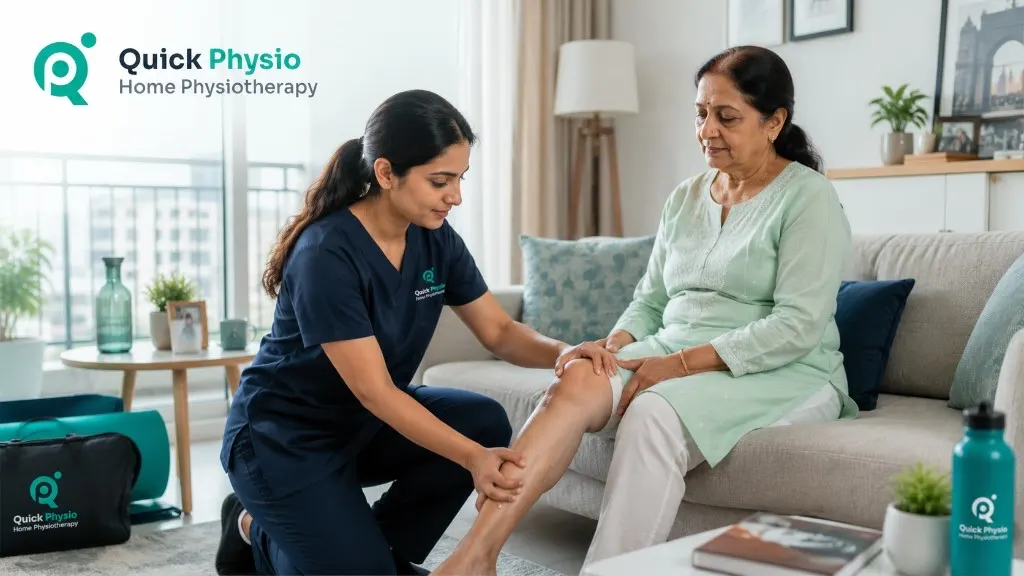
Quick Physio in Mumbai is home visits only. There is no clinic door here to walk into, and that is deliberate. Half of what I need to see is your actual chair, your actual staircase, and the two feet of floor beside your bed where the exercises will either happen or not happen. The first home session is ₹799 rather than the usual ₹1600, and most of that hour goes on looking and testing rather than on machines.
The local train leaves a signature. Standing commuters hold the overhead bar with one arm, take the weight of a laptop bag on the same shoulder, and brace through the lurch as the rake pulls out of Dadar or swings through Kurla. The neck shrugs, the mid-back rounds, and the standing leg takes a small jolt every few minutes. Central line riders tell me about the jerk; Western line riders tell me about the crush. Both are describing the same repeated bracing.
Car and cab commuters have the opposite problem and the same result. Ninety minutes on the Western Express Highway or the Eastern Express Highway is ninety minutes of unbroken hip and lumbar flexion, often with the wallet still in the back pocket and the clutch leg working stop-start traffic. Sustained flexion is not dangerous by itself. Sustained flexion twice a day, five days a week, with no extension anywhere in between, is what makes standing up at the gate feel stiff and mean.
Then there is home. Small flats push people onto the floor to eat, onto a low sofa to work, and into a kitchen where every turn is a pivot on a planted foot. Add four months of monsoon: damp air, slippery mosaic and kota floors that make everyone shorten their stride, and cancelled walks. Add Ganpati and Diwali weeks of squatting, cleaning and lifting idols and cartons. By the time someone messages me, the tissue has had a long year.
The session runs in a fixed order, because skipping steps is how people end up with exercises that suit somebody else. History first, then a safety screen, then movement, then strength and nerve testing, then hands-on assessment, then a functional test in your own space. Only after that do I choose treatment. If you want to read the underlying condition in more detail afterwards, the back pain guide covers the mechanics more slowly than I can in one hour.
Physiotherapy is not the right first stop for everything, and a home visit is not a licence to treat around something serious. There is a short list where I stop, explain why, and ask you to see a physician or orthopaedic surgeon before we continue. It is not a long list and most people never meet any of it, but it is the reason the screen happens before anything else.
If any of these are present, the answer is a medical review, not a set of exercises. I will still explain what I think is going on and what to ask the doctor, and I will not charge you for a treatment I do not think you should have that day.
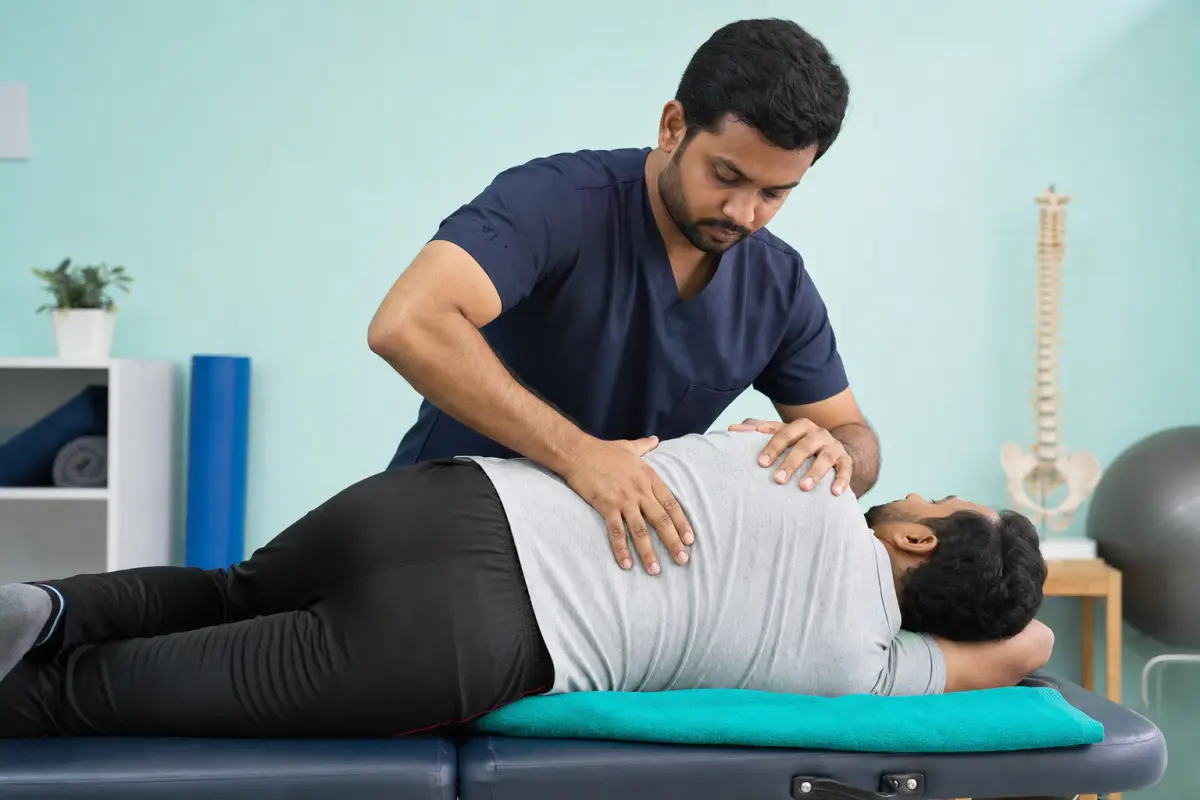
You will not get a twenty-exercise PDF. Most people leave with three, because three is what actually survives a week that includes a nine-hour day and a commute. The choice depends on what the assessment found, but for the commute-and-desk back that I see most often in Mumbai, these are the usual starting set. Every one of them is designed to be done without equipment, in the space you already have.
I do not promise a one-session reset and you should be wary of anyone who does. What I can give you is a realistic band based on what the assessment found, and a review point where we decide together whether the plan is working or needs changing. If there is no meaningful change by the review point, that is information, not a reason to keep booking sessions.
The pattern that gets better fastest is simple mechanical pain with no nerve signs, in someone who does the three exercises most days. The pattern that takes longest is a nerve-irritated back or an arthritic joint in someone whose commute cannot change. Both improve. They just improve on different clocks, and knowing which one you are on stops the second week from feeling like failure.
| Presentation | Sessions in the first block | When people notice a real change |
|---|---|---|
| Mechanical low back or neck pain, no nerve symptoms | 4 to 6 | 2 to 3 weeks |
| Back pain with leg referral or sciatic irritation | 6 to 10 | 4 to 8 weeks, often in stages |
| Knee osteoarthritis with stair difficulty | 8 to 12 | 6 to 12 weeks of steady loading |
| Frozen shoulder | 10 plus, over months | Slow, staged, measured in degrees not weeks |
| Post-surgical rehabilitation | Guided by the surgeon's protocol | Milestone-based, not calendar-based |
Mumbai geography decides the appointment, not a call-centre slot. Travel between Borivali and Chembur in the evening is not a fifteen-minute problem, so I ask for locality, building name, wing, and a two-hour window rather than an exact minute. Giving a precise time and then arriving forty minutes late in Western Express Highway traffic is not service, it is a guess dressed up as a promise. Locality pages such as physiotherapy in Mumbai list the areas currently covered.
Practically, you need very little. A firm chair, enough floor space to lie down with your knees bent, loose clothing rather than jeans, and any reports you already have. You do not need to buy a mat, a stepper, or a massage gun before the first visit. If equipment turns out to be genuinely useful, I will tell you what and why, and it will usually be something that costs very little.
The point of the first session is not to sell you a package. It is to work out whether what you have will respond to physiotherapy, how long that is likely to take, and what you can start doing tonight. Sometimes the honest answer is that you need a doctor first, or that three sessions and a habit change will be enough. That answer is worth the visit even when it is not the answer anyone expected.
No. A firm dining chair and enough floor to lie down with knees bent is genuinely all I need. I would rather see the flat as it normally is, because the sofa you actually sit on and the corner you actually work from are part of the assessment.
The testing is identical — movement, strength, neurological screening, joint assessment. What changes is context. In a clinic I have to imagine your staircase and your desk height. At home I watch you climb the stairs and sit at the desk, which usually shortens the guessing considerably.
It informs it, it does not decide it. Disc changes are extremely common on scans of people with no pain at all. What matters more is whether your symptoms follow a mechanical pattern, whether there are nerve signs on testing, and which specific movement reproduces your familiar pain.
Not in Mumbai. The service here is home visits across the city and the suburbs. For most of the presentations I see, that is an advantage rather than a compromise, because another hour of travel in traffic is often the very thing that flares the pain.
I will give you a range after the assessment, not before it, and I will set a review point. Simple mechanical pain often runs four to six sessions. Nerve-irritated backs and arthritic knees run longer. If nothing has shifted by the review point, we change the plan or refer, rather than quietly continuing.
Usually yes, with small edits. Switch the hanging arm, move the bag off the permanently loaded shoulder, and let the shrug drop between stations instead of holding it all the way. Taking two weeks off commuting is advice nobody in this city can follow, so I do not give it.
Then I say so in that session and tell you who to see. The red-flag screen exists precisely for this. Being told clearly that you need an orthopaedic or neurological opinion is a useful outcome, and it is better delivered in the first hour than in the sixth.
The regular corridors are the Western suburbs from Bandra up to Borivali, the Powai and Andheri East belt, Chembur and the central suburbs, plus Navi Mumbai and Thane. Send the locality and building when you book so the travel window is realistic rather than optimistic.
Home physiotherapy
₹1600 First session ₹799
Book ₹799 home physiotherapy (metro cities) →
Clinic Google Map on Contact page →
Assessment-led home physiotherapy across Mumbai — first home session ₹799 instead of ₹1600. We assess the stairs, the chair and the commute you actually have, then leave you with a plan you can keep.
5
33 Google reviews
Patient reviews
Real Google reviews for Quick Physio Physiotherapy & Rehabilitation Center — 5★ from 33 patients.
I had a wonderful experience at this therapy centre. The therapists are highly professional, compassionate, and genuinely dedicated to helping their clients. The environment is clean, welcoming, and comfortable, makin…
I had a very good experience at QuickPhysio Clinic. The physiotherapists are highly skilled, professional, and take time to understand the patient’s condition properly. The treatment was effective, and I noticed signi…
Great experience overall. The staff was polite and supportive, and the treatment sessions were handled with care and attention. The exercises and guidance provided were easy to follow and really helped with recovery.
I had been suffering from slip disc and cervical pain for quite some time, and after taking physiotherapy sessions at this center, I experienced significant relief. The therapists are highly skilled, professional, and…
Excellent work by doctor. Having a great experience till 5 day.
Assessment-led care at home across Ghaziabad & Delhi NCR — first home session ₹499.
Browse locations Contact & map