
Home physiotherapy
Ask our physiotherapist about your symptoms
₹1000 First session ₹499
Quick Physio Blog
The most common thing I treat in Bandra is a shoulder that gets nine hours of desk and three overhead gym sessions a week, and no hours of anything in between.
Home physiotherapy
₹1000 First session ₹499
If I had to name the single presentation that Bandra sends me most, it is a shoulder in a thirty-something who works in media, tech or finance, trains three or four times a week at a boutique studio off Linking Road or in a society gym, and cannot understand why a body that is clearly being exercised keeps hurting. The pain shows up reaching for a seatbelt, pulling a shirt off, or lying on that side at night.
The mechanics are almost always the same. The working day holds the shoulder blade in a forward, tipped position for eight or nine hours — laptop low, elbow unsupported, one hand on a phone. Then, three evenings a week, that same shoulder is asked to press, pull and hang overhead at full range with load. The blade has not moved properly all day and is suddenly required to rotate perfectly for forty-five minutes. Something in the middle gets irritated, and the middle is usually the rotator cuff tendon and the tissue around it.
What makes it stubborn in Bandra specifically is that nobody wants to stop training, and I do not think they should. Total rest reliably produces a shoulder that hurts less this week and is weaker next month. The work is figuring out which movements to keep, which to shelve for four weeks, and what to add so the blade stops being the weak link.
West sends me runners and studio injuries. The Carter Road and Bandstand promenade is where half of Bandra's cardio happens, and it is a hard, cambered surface that runs out after a couple of kilometres, so people loop it repeatedly. Repetitive looping on a camber loads one leg differently from the other — I see a lot of one-sided iliotibial band irritation and one-sided shin pain in Carter Road regulars that simply does not appear in people who run on a track. In the four monsoon months the promenade becomes unusable, everyone moves to the society treadmill or stops entirely, and the September restart produces its own wave of calf and Achilles complaints.
East sends me BKC desks. The glass towers there have excellent chairs and terrible habits — long AC hours, back-to-back video calls, and a laptop-plus-monitor setup where the monitor is central and the laptop sits off to one side, so the neck spends the day rotated ten degrees to the left. That asymmetry is invisible until you ask someone to turn their head both ways and one side stops early.
The Pali Hill and Khar border pocket adds a building factor. Older low-rise buildings and bungalow conversions there often have no lift and a steep internal staircase, while the newer towers have lifts but a long walk from the gate through a podium to the lobby. Neither is a problem in itself. Both matter when I am deciding how much walking load a healing Achilles or a sore knee is already getting for free.
People arrive expecting me to tell them to stop lifting. I almost never do. Loaded exercise is the most reliable tool I have for making a tendon tolerate more, and the people who train are usually easier to rehabilitate than the people who do not, because they already own the habit. The problem is rarely the training itself. It is the ratio between the training and everything else.
That said, three patterns do cause genuine trouble and they show up repeatedly in Bandra studios. The first is an overhead-heavy week with no pulling to balance it. The second is a jump in volume after a break — a fortnight in Goa, then straight back into the same class at the same weight. The third is a class format where the clock decides the tempo, so form quietly degrades in the last two rounds and the shoulder finishes each set in a compromised position thirty times over.
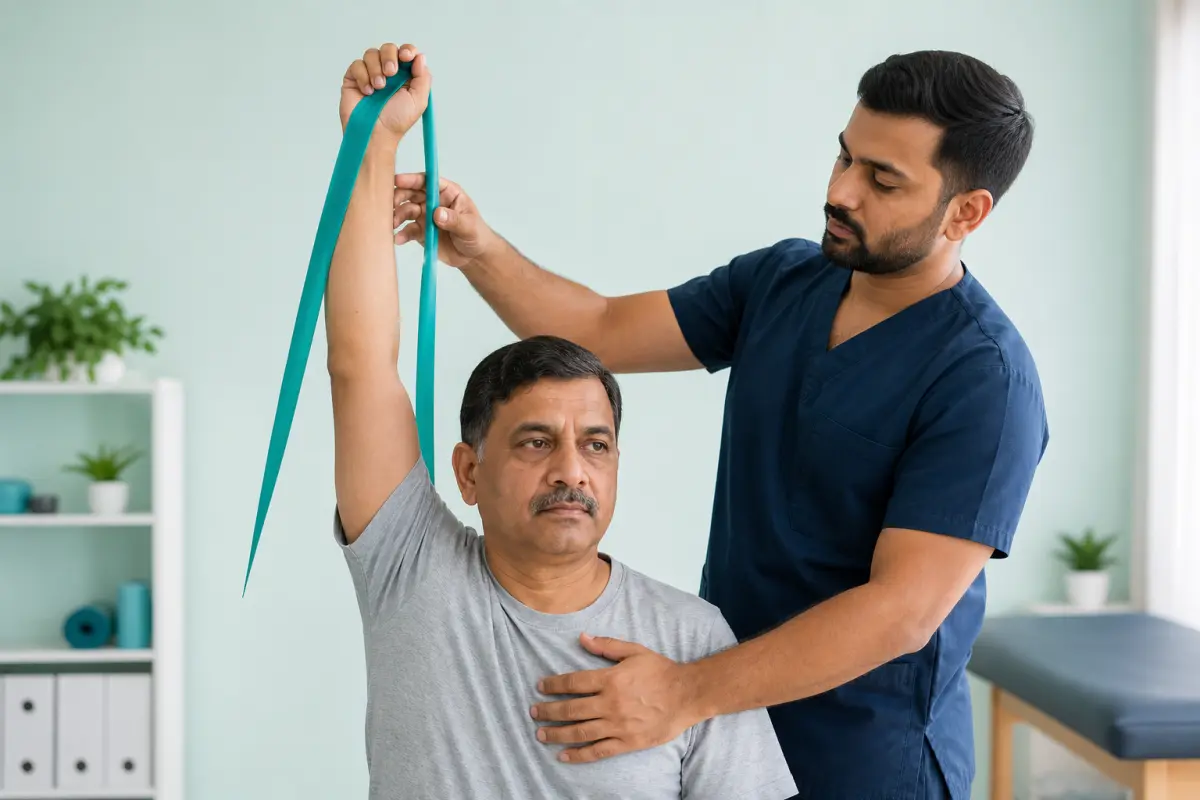
So the conversation is about modification, not abstinence. Shelve overhead pressing and behind-the-neck work for a few weeks. Keep everything below shoulder height. Add pulling volume. Slow the eccentric phase down so the tendon gets the kind of load it responds to. The rotator cuff injury guide sets out the underlying tissue behaviour if you want the longer version.
A shoulder assessment does not need a clinic. It needs about forty minutes, a wall, and a chair. The first home session is ₹799 instead of the usual ₹1600, and the bulk of it is testing, because a shoulder that hurts on the same movement can have four different reasons and they need four different plans.
Most cranky shoulders are irritable tendons and they get better. A small number are not, and those need imaging or an orthopaedic opinion before any loading programme. I run this list in the first ten minutes.
If one of these is present, I will not treat it that evening. I will explain what I think it is, what investigation is likely, and who to see.
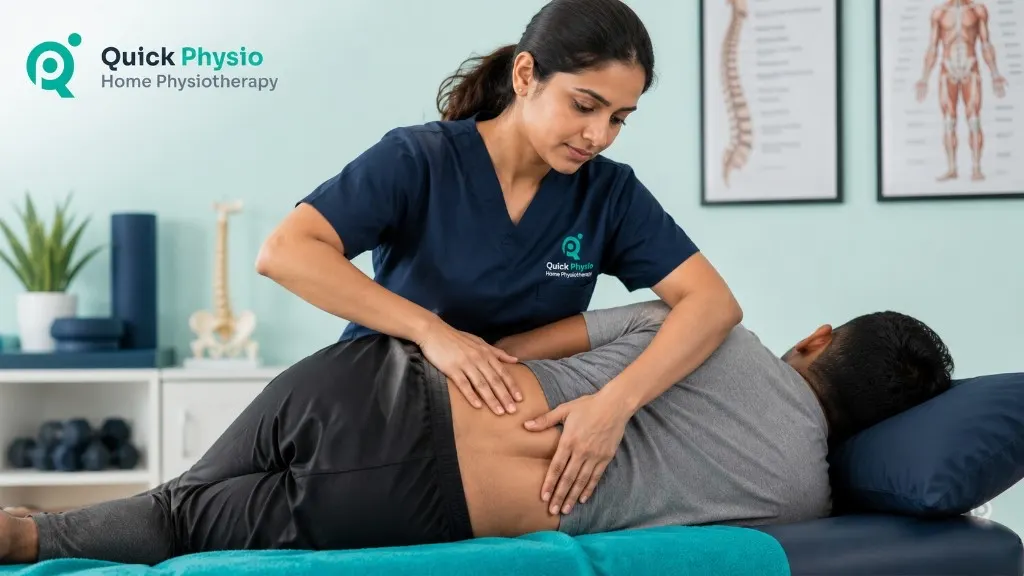
These are the ones I leave most often, and they are deliberately unglamorous. A shoulder gets better on boring, repeated, sub-maximal load, not on a new stretch. Do them on the days you train as well as the days you do not.
An irritable rotator cuff tendon typically takes six to twelve weeks of consistent loading to change meaningfully. Pain often drops in the first two or three weeks, which is the most dangerous moment in the whole process, because that is when people return to the overhead programme at the old weight and land back at week one. Capacity lags comfort by about a month. I tell everyone that number on day one specifically so week four does not become a relapse.
For the Carter Road running injuries the arc is shorter — four to eight weeks for most shin and iliotibial band irritation, provided the weekly distance is rebuilt gradually and the camber direction gets alternated. Post-monsoon restarts need roughly three weeks of lower volume before returning to the pre-break distance, which almost nobody wants to hear in the last week of September.
Practically, Bandra visits work best in the evening after office hours, and I ask for building name, wing and the lane rather than a general area, because the West lanes off Turner Road and Pali Hill are hard to find at speed. Quick Physio does not operate a clinic in Bandra — this is home physiotherapy, which in practice means I get to see your desk and your gym bag, and that is usually where the answer is hiding.
Almost never completely. What usually goes is overhead pressing, behind-the-neck work and anything that finishes in a compromised position when you are tired. Everything below shoulder height, all lower body work and all pulling generally stays in the programme.
Posture is a contributing factor, not a diagnosis. Plenty of people sit exactly as you do with no shoulder pain at all. What separates them is usually tissue capacity — how much load the tendon and the shoulder blade muscles can tolerate before they complain. That is trainable.
The surface is hard and cambered, which is worth managing, but the bigger issue I see is loop direction. Running the same promenade loop the same way every time loads one hip and one shin consistently more than the other. Alternating direction costs nothing and helps.
Usually the monitor arrangement. If the external screen is straight ahead and the laptop sits open to one side, you spend the day rotated slightly towards one of them. Work-from-home setups are often worse ergonomically but more varied, and variety is what the neck actually wants.
Tendinosis describes tissue that has changed under load, and it is extremely common in scans of people who train, including people with no symptoms at all. It tells us the tissue needs graded loading rather than rest. It does not mean the shoulder is damaged beyond repair.
As well as, not instead of. A class gives you general load in a group setting. The three exercises target the specific range and the specific direction that tested weak in your shoulder, at a dose I picked. Once the shoulder tolerates the class fully, the specific work can taper.
Pain often eases within two to three weeks. Strength and load tolerance take six to twelve. The gap between those two numbers is where most re-injuries happen, so I would rather you plan for the longer figure and be pleasantly surprised.
Yes, the whole Bandra to Santacruz stretch on both sides of the highway is a regular corridor, including the Khar border lanes. Send the building name and lane when booking, because navigating the West lanes at speed in the evening is the slowest part of the trip.
Home physiotherapy
₹1600 First session ₹799
Book ₹799 home physiotherapy (metro cities) →
Clinic Google Map on Contact page →
Shoulder, neck or running pain from Bandra desks and studios? Book a home visit — first session ₹799 instead of ₹1600, with an assessment done at your own desk and a training plan you can keep.
5
33 Google reviews
Patient reviews
Real Google reviews for Quick Physio Physiotherapy & Rehabilitation Center — 5★ from 33 patients.
I had a wonderful experience at this therapy centre. The therapists are highly professional, compassionate, and genuinely dedicated to helping their clients. The environment is clean, welcoming, and comfortable, makin…
I had a very good experience at QuickPhysio Clinic. The physiotherapists are highly skilled, professional, and take time to understand the patient’s condition properly. The treatment was effective, and I noticed signi…
Great experience overall. The staff was polite and supportive, and the treatment sessions were handled with care and attention. The exercises and guidance provided were easy to follow and really helped with recovery.
I had been suffering from slip disc and cervical pain for quite some time, and after taking physiotherapy sessions at this center, I experienced significant relief. The therapists are highly skilled, professional, and…
Excellent work by doctor. Having a great experience till 5 day.
Assessment-led care at home across Ghaziabad & Delhi NCR — first home session ₹499.
Browse locations Contact & map