
Home physiotherapy
Ask our physiotherapist about your symptoms
₹1000 First session ₹499
Quick Physio Blog
Sector 62 stacks sprint stand-ups, low monitors, and Noida Expressway commutes into one cervical load. Here is why software engineers there feel neck pain more than ever — and what actually helps.
Home physiotherapy
₹1000 First session ₹499
If you write code or manage sprints in Noida Sector 62, your neck probably knows the schedule before you do. By Thursday afternoon the upper traps feel concrete, the base of the skull hums, and turning to check a second monitor feels like rusted hinges.
This is not random bad luck. Sector 62 — along with neighbouring pockets like Sector 63, 125, and the Candor Techspace corridor — concentrates a specific day design: long sit blocks, dual-monitor farms, back-to-back stand-ups, and a commute that never truly unloads the spine.
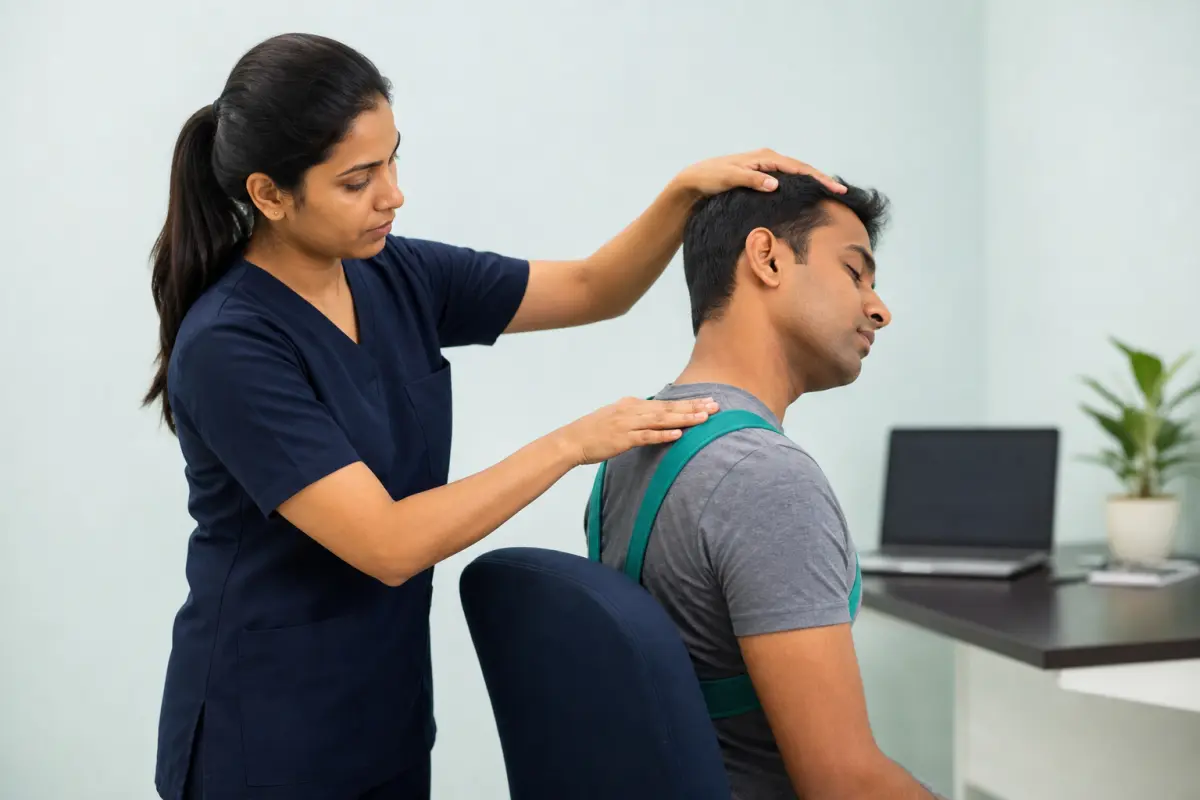
I am Dr. Yashika Chaudhary, a physiotherapist who sees Noida IT professionals at home. This article explains why neck pain in software engineers here has risen — and what assessment-led care changes when generic stretching has failed.
Whether you sit in Corenthum, walk the long corridor at Logix Cyber Park, or hybrid from Sector 132, the mechanics are similar even when the employer logo changes. Understanding that stack is the first step toward pain that stops owning your Thursday afternoons.
Neck pain among Noida software engineers is usually mechanical — joints, muscles, and nerves irritated by sustained postures and load, not a mystery infection. It often sits with upper trap tension, headaches at the base of the skull, and sometimes referral into the shoulder.
The NHS describes neck pain as common and often linked to posture and stress. That matches what we see from Logix Cyber Park to Corenthum: pain that worsens with screen time and eases briefly on holidays — then returns Monday.
Related patterns overlap with shoulder strain and cervicogenic headache. If leg symptoms appear, we screen separately for sciatica — but pure neck presentations dominate Sector 62 consults.
Most Sector 62 desks have two 24-inch panels. If the top third of the screen sits below eye level, the chin drifts forward for eight to nine hours. The cervical extensors and upper traps pay the bill by 4 pm.
Agile teams schedule stand-ups back-to-back. People lean on desks, cradle phones, or stare down at laptops on kitchen counters in hybrid weeks. The neck never gets a neutral hour — only different irritants.
Cab or car flexion after a full desk day keeps the spine bent. Add a one-shoulder laptop bag through Electronic City Metro and the upper quarter never resets before sleep.
Two office days with a proper chair, three WFH days on a dining chair or sofa — the neck experiences that as whiplash in slow motion. We covered cervical patterns in our Noida cervical guide; here the focus is Sector 62 sprint culture.
Release deadlines shrink break windows. The WHO physical activity fact sheet recommends reducing sedentary time — yet many engineers sit through lunch for three years straight.
Stiffness at the base of the skull by mid-afternoon. Needing to crack the neck. Tight upper traps during code reviews. Pain that eases on Sunday and returns Monday stand-up.
Headaches starting at the neck and moving forward. Pain when checking blind spots while driving on the Expressway. Sleep disturbed when the pillow feels "wrong" every night.
Persistent pain beyond six weeks. Arm tingling with certain desk angles. Reduced turning range that affects driving and sport. Anxiety about "something serious" from an old MRI report.
Progressive arm weakness, dropping objects, fever with neck stiffness, trauma, or unexplained weight loss. These are not desk-stretch problems. Book medical review first.
Rohan, 31, leads a payments squad at Stellar IT Park. His day: 9 am stand-up on a laptop below eye line, four hours of dual-monitor coding, lunch at the desk, three more hours of reviews, then a cab to Sector 126 society.
He bought a standing desk in 2024 but stands wrong — locked knees, screen still low, no breaks. By March 2026 his neck pain ran into Friday evenings. Trap stretches helped twenty minutes; then the sprint board reloaded the pain.
On a home visit we raised his external monitor, moved the mouse closer, and dosed chin tucks plus scapular work he could do between stand-ups. Four weeks later he still had stressful weeks — but pain no longer owned Thursday.
— Dr. Yashika Chaudhary, PT
In Sector 62 I rarely meet a "weak neck." I meet a strong neck asked to hold a forward-head load for nine hours, then commute flexed, then scroll in bed. Fix the load before you chase supplements or aggressive cracking.
Sector 62 Desk Audit — 10 Points
| Factor | Pain-Friendly Setup | Common Pain Setup |
|---|---|---|
| Screen height | Top edge near eye level | Laptop flat on desk |
| Keyboard | Separate, elbows at 90° | Laptop keyboard while looking down |
| Breaks | Stand every 40 min | Breaks only when pain screams |
| Phone | Headset or speaker | Shoulder cradle during stand-ups |
| Hybrid | Same rules at home | Sofa laptop on WFH days |
Before the cab to Sector 126 society, spend two minutes waking the spine — not aggressive stretching. Chin tuck, shoulder rolls, and a short walk to the lift beat a stiff start on the Noida Expressway.
At Candor Techspace or Logix Cyber Park, set a 40-minute sit timer. Stand, refill water, and reset screen height after the first stand-up block. Your neck and back load is cumulative; micro-breaks are medicine.
Eat away from the desk when possible. A 10-minute walk around the campus or a stair flight changes hip and spine loading more than another trap stretch at your chair.
This is when Noida IT pain peaks — 3 pm to 5 pm. Swap one meeting for a walking call if policy allows. If not, do 90 seconds of scapular resets between calls.
Commute home via Electronic City Metro or cab with both bag straps or a backpack. One-shoulder laptop bags are a quiet neck and upper-back irritant five days a week.
Phone scrolling in bed extends the same forward-head pattern. Keep the screen at eye level even for 10 minutes of messages, or use voice notes instead.
Prevention in Noida IT is boring on purpose — repeatable beats heroic. One setup fix, one break rule, one commute unload habit per week until they stick.
Raise screens before buying gadgets. Unload bags before the metro gate. Keep hybrid days honest: if office chair works, replicate height at home with books or a stand.
Team leads can normalise camera-off walking minutes — culture change reduces neck load more than a single wellness webinar.

Stop any exercise that increases arm numbness, dizziness, or sharp pain. These are starting doses — your physiotherapist will adjust irritability.
**Purpose:** Retrain deep neck flexors and reduce forward-head load.
**How to do it:** Sit tall. Gently draw chin straight back — like making a double chin — without looking down. Hold, release.
**Reps / hold:** 8–10 reps, 3 sec hold
**Common mistakes:** Looking down while tucking; forcing hard
**Who should avoid or modify:** Acute whiplash or dizziness — modify with physio
**Purpose:** Ease overactive traps after long monitor time.
**How to do it:** Sit tall. Gently tilt ear toward shoulder; opposite hand behind back optional. Hold mild stretch.
**Reps / hold:** 20–30 sec each side, 2 rounds
**Common mistakes:** Shrugging shoulder up; bouncing
**Who should avoid or modify:** Recent nerve irritation with arm symptoms — gentler dose
**Purpose:** Rebuild mid-back support so neck stops overworking.
**How to do it:** Sit or stand. Squeeze shoulder blades down and together. Hold without hiking shoulders.
**Reps / hold:** 10 reps, 5 sec hold
**Common mistakes:** Over-arching lower back; breath holding
**Who should avoid or modify:** Acute shoulder impingement — reduce range
**Purpose:** Open stiff upper back that forces neck flexion.
**How to do it:** Mid-back on chair edge. Hands behind head. Extend over edge in small range.
**Reps / hold:** 8–10 reps
**Common mistakes:** Cranking neck backward
**Who should avoid or modify:** Osteoporosis or acute rib pain — skip
**Purpose:** Target side-neck tightness from mouse reach.
**How to do it:** Turn head 45° toward armpit. Gently look down. Hold stretch.
**Reps / hold:** 20 sec each side
**Common mistakes:** Pulling aggressively with hand on head
**Who should avoid or modify:** Vertigo history — slow and small
**Purpose:** Train scapular control and upright posture.
**How to do it:** Back against wall. Arms in W shape. Slide up and down keeping contact.
**Reps / hold:** 8–10 slow reps
**Common mistakes:** Arching away from wall; rushing
**Who should avoid or modify:** Frozen shoulder — modify range
**Purpose:** Build capacity for sustained neutral head.
**How to do it:** Chin tuck lying down. Lift head slightly off floor. Hold without jaw clench.
**Reps / hold:** 5–8 holds of 10 sec
**Common mistakes:** Straining front of neck; breath hold
**Who should avoid or modify:** High blood pressure uncontrolled — caution
**Purpose:** Reduce rounded shoulders that pull neck forward.
**How to do it:** Forearm on door frame. Step through until chest stretch. Hold.
**Reps / hold:** 30 sec each side
**Common mistakes:** Flaring ribs; forcing deep step
**Who should avoid or modify:** Recent shoulder surgery — wait for clearance
**Purpose:** Strengthen rotator cuff to support shoulder-neck chain.
**How to do it:** Light band or no weight. Elbow at side. Rotate forearm up.
**Reps / hold:** 12 reps each side
**Common mistakes:** Elbow drifting from ribs
**Who should avoid or modify:** Acute shoulder pain — defer loading
Your first session maps irritability, range, neurological signs, and the tasks that reload pain — laptop height at Candor Techspace, cab flexion, or sofa WFH. We screen red flags before loading. More on neck-pain patterns.
Hands-on care may include soft-tissue release, joint mobilisation, or dry needling when appropriate — always matched to irritability, not as a forever crutch.
Heat, ice, TENS, or ultrasound can support comfort in acute phases. They do not replace movement and strength; we use them to help you enter exercise sooner.
Graded mobility, scapular control, and capacity work matched to your Noida workday — not a generic gym PDF. You leave with two or three repeats for between meetings.
Mild mechanical patterns may shift within two to four weeks of consistent habits plus sessions. Longer histories need staged loading over six to twelve weeks. We set review points — not miracle promises.

Home visits remove the friction of a post-7 pm clinic hop down the Noida Expressway. We assess your actual chair, mattress, and laptop stack — not an ideal desk in a brochure.
Book via home-session-199 or metro-home-199. Name Sector 62, 63, 125, 126, or your society so arrival windows stay honest.
Our Noida location page covers IT corridors from Logix Cyber Park to Stellar IT Park. First session is ₹499 — assessment-led, not a sales pitch.
Seek urgent medical review for progressive arm or leg weakness, bowel or bladder changes, unexplained weight loss, fever with spine pain, trauma, or night pain that will not settle.
The NHS neck pain guidance and MedlinePlus back pain overview align with what we screen on home visits — mechanical care helps many patterns, but red flags need a doctor first.
Priya, 28, tested releases for a fintech near Express Trade Tower. Neck pain started as "Monday stiffness" and became daily by Q1 2026. She tried a massage gun, then YouTube yoga, then ignored it through a release crunch.
Home assessment found dual monitors 8 cm too low, mouse too far, and hybrid WFH on a bed desk. No red flags on screening.
Plan: setup fixes day one; chin tucks and scapular work; two follow-up home sessions over three weeks. She reported 60% less afternoon pain by week three — not zero stress, but pain no longer drove her calendar.
She still books tune-up sessions before major releases. Maintenance beats crisis.
| What you feel | Likely mechanical driver | First action |
|---|---|---|
| Base-of-skull headache | Forward head + trap overload | Raise screen; chin tucks |
| Pain turning to check mirror | Joint stiffness + muscle guard | Gentle rotation; book physio |
| Arm tingling at desk | Nerve irritation from posture | Setup fix; medical screen if persistent |
| Sunday relief, Monday return | Workload posture pattern | Audit desk + breaks |
| Pain with phone cradle | Side-neck compression | Switch to headset |

Imagine a vertical timeline: 8 am cab flexion → 10 am low monitor → 1 pm desk lunch → 4 pm trap peak → 8 pm sofa scroll. Each block lists one fix — raise screen, walk lunch, headset, phone ban in bed. HR teams in Sector 62 can print this for workstation audits.
Software engineers in Noida Sector 62 are not fragile — their days are stacked. Neck pain rises when monitor height, meeting culture, commute, and hybrid setups never let the cervical spine reset. Change the load, build capacity, and book assessment when self-care plateaus.
If pain has outlasted two weeks of self-management, early assessment beats another quarter of delayed booking. Mechanical patterns respond to setup, breaks, and graded loading — when red flags are ruled out.
**Book Home Physiotherapy in Noida at ₹499** — assessment-led first home session for Sector 62, 63, 125 and IT park professionals. Open metro-home-199.html, select Noida, and name your locality.
Meeting density and monitor farms are concentrated here. The anatomy is the same — the day design is denser than many walkable campuses.
Only if height, breaks, and screen position also change. Standing wrong for hours can irritate traps too.
We target Sector 62 patterns — stand-ups, dual monitors, Expressway commute — not a one-size PDF.
Most mechanical neck pain does not need imaging upfront. Red flags or progressive neurological symptoms warrant medical review and possible imaging.
Yes. Book via metro-home-199 and name your sector. Same IT corridor patterns apply.
Assessment-led home visit — screening, setup review, and a starter plan. Follow-up frequency is explained after we see your pattern.
Often. See our shoulder strain guide if overhead reach or AC joint pain dominates.
Mild patterns sometimes turn in two to four visits plus habits. Longer histories need staged loading over weeks — we set review points early.
Usually yes. We modify setup and dose rather than asking you to disappear from sprint work.
Progressive weakness, trauma, fever with stiffness, or unexplained weight loss — medical first.
Home physiotherapy
₹1200 First session ₹599
Book ₹599 home physiotherapy (metro cities) →
Clinic Google Map on Contact page →
Assessment-led first home session for Sector 62, 63, 125 and IT park professionals. Book via metro-home-199.html — select Noida and add your locality.
5
33 Google reviews
Patient reviews
Real Google reviews for Quick Physio Physiotherapy & Rehabilitation Center — 5★ from 33 patients.
I had a wonderful experience at this therapy centre. The therapists are highly professional, compassionate, and genuinely dedicated to helping their clients. The environment is clean, welcoming, and comfortable, makin…
I had a very good experience at QuickPhysio Clinic. The physiotherapists are highly skilled, professional, and take time to understand the patient’s condition properly. The treatment was effective, and I noticed signi…
Great experience overall. The staff was polite and supportive, and the treatment sessions were handled with care and attention. The exercises and guidance provided were easy to follow and really helped with recovery.
I had been suffering from slip disc and cervical pain for quite some time, and after taking physiotherapy sessions at this center, I experienced significant relief. The therapists are highly skilled, professional, and…
Excellent work by doctor. Having a great experience till 5 day.
Assessment-led care at home across Ghaziabad & Delhi NCR — first home session ₹499.
Browse locations Contact & map