
Home physiotherapy
Ask our physiotherapist about your symptoms
₹1000 First session ₹499
Quick Physio Blog
Lower Parel's towers run on ten-hour calendars with no gap between meetings, and the commonest thing I am called for is not back pain — it is a one-sided headache that starts at the base of the skull around four in the afternoon and is blamed on screens.
Home physiotherapy
₹1000 First session ₹499
The Lower Parel working day has a shape that I can almost set my watch by. Calls start at nine-thirty and are scheduled back to back until seven, because the calendar software will happily fill every slot. Nobody stands up. Lunch is eaten at the desk during a call with the camera off. And somewhere around four in the afternoon, a dull ache begins at the base of the skull on one side, climbs over the ear, and settles behind the eye. By eight it is a headache, and the person takes a painkiller and books a session for their eyes.
That pattern — one-sided, starting in the neck or occiput, spreading forward to the forehead or behind the eye, worse after sustained neck positions, better after moving around — is the classic presentation of a cervicogenic headache. It is a headache generated by structures in the upper neck, usually the joints and muscles of the top three cervical segments, and it is very common in people who hold their head still in front of a screen for nine or ten hours.
The reason it matters to name it correctly is that a cervicogenic headache responds well to treating the neck and poorly to everything else. People spend months on eye tests, screen filters, hydration advice and increasing doses of over-the-counter analgesics, none of which touch a joint that is stiff and irritable at C1 to C3. And the analgesics have their own trap, which I come to later.
The towers along Senapati Bapat Marg and the converted mill compounds — Kamala Mills, Todi Mills, the Phoenix side, Peninsula and the Indiabulls buildings — have excellent desks and, in most cases, decent chairs. The chair is rarely the problem. The problem is the combination of duration, immobility and the specific ergonomics of laptop-plus-external-monitor, which is close to universal in this belt.
A laptop screen sits low. An external monitor sits at the correct height. Using both means the head rotates and tips towards one of them, and because people put the monitor on whichever side the desk allows, that rotation is consistent and one-directional for years. Side-locked headaches and one-sided neck pain follow the same side with striking reliability, and that is usually the first thing I ask about when a patient can point to which side of their head hurts.
Then there is the video-call posture, which is distinct from ordinary desk posture. On camera people hold themselves still, sit more upright than is comfortable, and keep the head forward towards the microphone. Holding still is the load — the deep stabilising muscles of the neck are endurance muscles, and asking them to maintain a fixed position for fifty minutes at a stretch, eight times a day, is genuinely beyond their conditioning in most desk workers. Clenching the jaw during difficult calls adds another layer, and jaw and upper neck tension travel together more often than people realise.
The station walk is part of the picture. Anyone coming in via Lower Parel or the Prabhadevi side does the narrow overbridge crush and then a long fast walk to the tower with a laptop bag on one shoulder, twice a day. That is fifteen minutes of one-sided loading immediately before and immediately after nine hours of neck immobility, and it lands on the same side every time because bag habits do not change on their own.
The gym pattern here is its own risk. Corporate schedules push training into a six a.m. slot or a ten p.m. slot, and because there is only time for three sessions a week, those sessions tend to be heavy. Overhead pressing and heavy shrugs on a neck that has been static all day is a combination I see produce flares reasonably often. I do not tell people to stop lifting; I ask them to shift the pressing volume and add the mobility work before the session rather than after.
And the monsoon changes behaviour here too. The Lower Parel and Elphinstone stretch waterlogs badly, so people simply stay in the office until the water clears, which turns a ten-hour day into a thirteen-hour one several times a week in July and August. During those months I set a lower, more realistic exercise target rather than pretend the schedule is the same as it is in February.
This is where a proper examination earns its keep, because headache is a symptom with many causes and the management differs enormously. My first job is to work out whether this is cervicogenic, tension-type, migraine, or a mix, and the history does most of that work. Cervicogenic headaches tend to stay on one side, start in the neck, and be provoked by neck position and movement. Migraine is more often throbbing, comes with nausea or light and sound sensitivity, and may switch sides between attacks. Tension-type headache is usually bilateral and band-like. Plenty of people have two of these at once, which is why the examination rather than the label guides treatment.
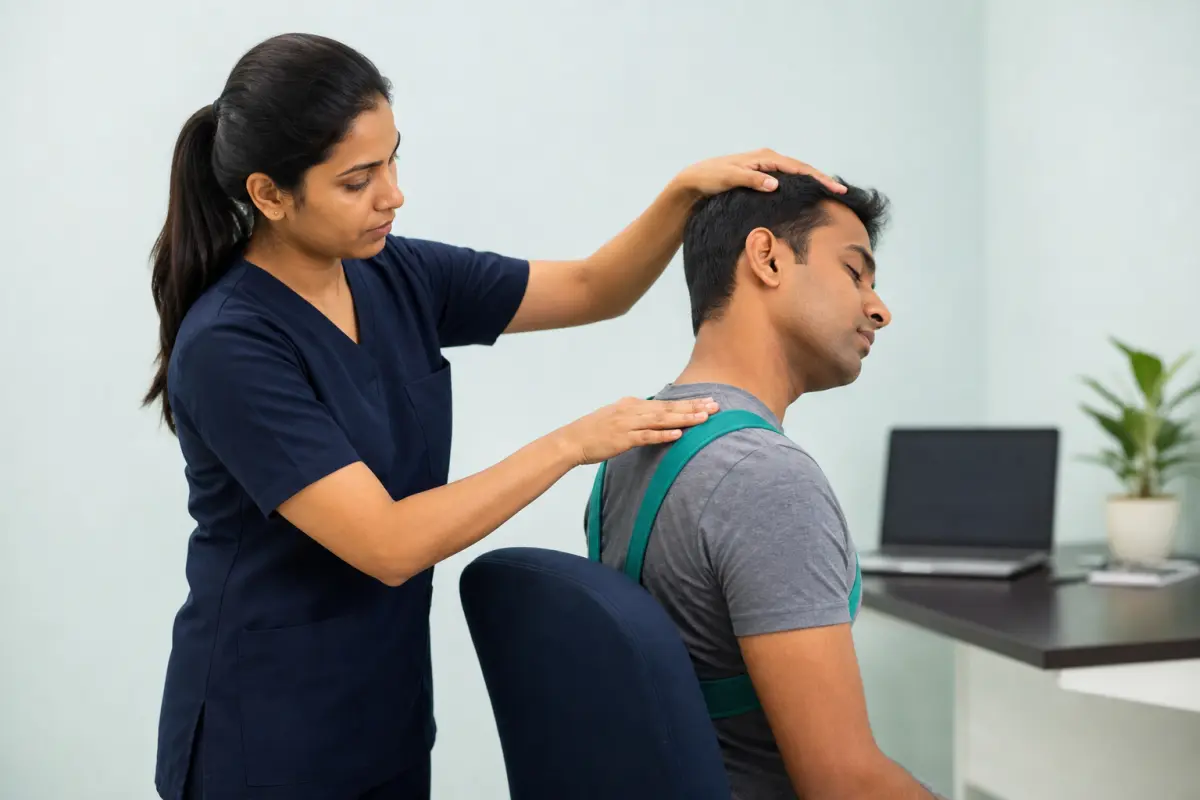
The single most useful physical test is the cervical flexion-rotation test, which isolates rotation at the C1–C2 segment. I flex the neck fully and then rotate the head, measuring how far it turns each way. A clear side-to-side difference, on the same side as the headache, is a strong indication that the upper cervical spine is involved. I then examine the upper cervical segments manually to see whether pressure on a specific joint reproduces the patient's familiar headache — not just any pain, but the actual headache they came to me about. That reproduction is the finding that changes the plan.
Alongside that I test deep neck flexor endurance with a graded craniocervical flexion task, check scapular endurance, assess thoracic rotation and extension, and screen the arm neurologically if there is any symptom below the shoulder. I also ask about jaw clicking, morning jaw soreness and whether a partner has mentioned night grinding, because managing an upper neck without addressing significant bruxism is a partial job.
I ask how many days a month you take something for the headache. If the answer is more than ten to fifteen days a month, sustained over three months or more, medication overuse headache becomes a real possibility — the treatment itself starts to perpetuate the daily headache. That is a conversation for your doctor rather than something I manage, but I raise it, because it is common in this population and almost nobody has been asked the question directly.
A sudden, severe headache that reaches maximum intensity within a minute or two — the 'worst headache of my life' — is a medical emergency. Go to hospital, do not call a physiotherapist. The same applies to a headache with fever and a stiff neck, a headache following any head injury, and a headache accompanied by weakness, slurred speech, facial droop, confusion, a seizure or visual loss.
Other patterns needing prompt medical assessment: a headache that is consistently worse when lying flat or that wakes you from sleep, particularly with vomiting; a new type of headache beginning after the age of fifty, especially with tenderness of the scalp or jaw pain when chewing; a new or changing headache in someone with cancer, HIV or on immunosuppression; and a headache in pregnancy with visual disturbance or swelling.
I include this list in detail because headache is the one presentation where physiotherapists most need to know their limits. The overwhelming majority of Lower Parel desk headaches are mechanical and treatable, but a blog that tells you how to self-treat a headache without telling you when not to is not giving you the full picture.
For cervicogenic headache the combination that works best is manual therapy to the upper cervical segments together with specific exercise — either alone is less effective than both. In practice that means graded joint mobilisation at the segments that reproduced the headache, soft tissue work to the suboccipital muscles and upper trapezius, and then a small, precise home programme. Many patients notice a reduction in headache frequency within two to three sessions, which is fast enough to keep people engaged with the boring part.
The home programme has to fit between meetings, because that is the only time that exists. I keep it to three exercises and one calendar rule, and the calendar rule is the one I argue hardest for.
Sit upright, loop a rolled hand towel around the back of the neck just under the skull, hold both ends, and gently rotate the head towards the stiffer side while using light tension on the towel to keep the segment supported. Hold twenty seconds, five repetitions each side. Cue: 'turn as if looking over your shoulder, but keep the movement at the very top of the neck.' It should feel like a stretch, never sharp, and never produce dizziness — if it does, stop and tell me.
Stand with your back to a wall, arms out at shoulder height with elbows bent to ninety degrees, backs of the hands and elbows touching the wall. Hold thirty seconds without letting the low back arch or the hands drift off the wall. Three holds. Cue: 'ribs down, hands stay on the wall, breathe normally.' Most desk workers find this genuinely hard at first, and that difficulty is the deficit we are treating.
Sit on your chair, cross your arms over your chest, and rotate the upper body slowly to each side, going a little further each repetition. Eight per side. Cue: 'turn from the ribcage, keep the hips and knees facing forward.' A mid-back that has not rotated all day forces the neck to compensate on every turn towards the second monitor, so this small movement removes a surprising amount of daily cervical load.
Set calls to end at twenty-five or fifty minutes rather than on the hour, and stand up in the gap, even for sixty seconds. This is the intervention with the largest effect and the lowest compliance, because it requires changing a meeting culture rather than a body. I ask people to start by protecting two gaps a day rather than all of them, since a rule that is broken by ten a.m. stops being a rule.
For a cervicogenic headache of recent onset, most people notice a meaningful drop in headache frequency within two to four weeks, across roughly four to six sessions, with the home programme continuing alongside. Where the pattern has been present for a year or more, the headaches usually become less frequent and less intense on a similar timeline but the neck needs three months of endurance work before the gains hold without ongoing treatment. Mixed presentations with a migraine component are less predictable, and those are better managed jointly with a doctor.
What I try hardest to set expectations about is that this is a load-driven condition. The treatment improves the tissue's tolerance; the calendar determines the demand. If the demand goes back to nine hours of held stillness the week after discharge, the symptoms return, and that is not a failure of the treatment. It is the reason the calendar rule is part of the prescription rather than a lifestyle suggestion.
Quick Physio in Mumbai works as home visits, which for this group is mostly a scheduling advantage — early morning and late evening slots at your flat in Lower Parel, Parel, Prabhadevi or the Worli side, without adding a journey to a day that already has too many. It also means I see the actual desk, the monitor position and the chair you use at home on remote days. A first home visit is charged at ₹799 instead of the usual ₹1,600.
The most useful clues are side and starting point. Cervicogenic headaches usually stay on one side, begin at the back of the head or upper neck and spread forward, and are provoked by sustained neck positions. Migraine more often throbs, brings nausea or light sensitivity, and can switch sides. Examination adds the rest — particularly whether pressure on a specific upper neck joint reproduces your exact headache.
It changes your hips and legs more than your neck. If the monitor position and the head rotation stay the same, standing does not remove the load that is causing a cervicogenic headache. It is still worth having, because alternating positions is genuinely useful — but on its own it is not the answer people are sold.
Dizziness needs to be characterised before anyone works on your neck. Some upper cervical problems cause a mild unsteadiness that improves with treatment, but dizziness can also have causes that make certain techniques inappropriate. I screen for it specifically, I avoid end-range rotation techniques where there is any concern, and I refer for medical assessment when the picture is unclear.
Do not stop anything abruptly on a blog's advice. But do count the days — if you are taking something for headache more than ten to fifteen days a month over several months, mention it to your doctor, because the medication can begin to sustain the headache. I will ask about it at the assessment and can explain the pattern, but withdrawal should be planned medically.
I treat at residences rather than in offices. Practically, an office has no privacy for an examination that involves lying down, and no realistic way to protect an hour. For Lower Parel patients the early morning or post-nine-pm home slot is what actually gets used, so that is what I offer.
A sensible setup helps and is worth doing, but I would rank it third. Monitor height and the side you rotate towards matter more than the chair, and how often you break the static hold matters more than both. If your employer offers an assessment, take it — just do not expect it to substitute for neck endurance work.
Many people get some immediate ease in neck movement after the hands-on work, and it is common to have a slightly heavy or achy neck for twenty-four hours afterwards, which then settles. The more meaningful marker is headache frequency over the following two weeks — that is the number I ask you to track, not how you feel that evening.
Home physiotherapy
₹1600 First session ₹799
Book ₹799 home physiotherapy (metro cities) →
Clinic Google Map on Contact page →
One-sided headache and a stiff neck by the end of a ten-hour calendar? A Quick Physio physiotherapist visits your Lower Parel or Prabhadevi home, tests whether the headache is coming from your upper neck, and treats it. First home visit ₹799 instead of the usual ₹1,600.
5
33 Google reviews
Patient reviews
Real Google reviews for Quick Physio Physiotherapy & Rehabilitation Center — 5★ from 33 patients.
I had a wonderful experience at this therapy centre. The therapists are highly professional, compassionate, and genuinely dedicated to helping their clients. The environment is clean, welcoming, and comfortable, makin…
I had a very good experience at QuickPhysio Clinic. The physiotherapists are highly skilled, professional, and take time to understand the patient’s condition properly. The treatment was effective, and I noticed signi…
Great experience overall. The staff was polite and supportive, and the treatment sessions were handled with care and attention. The exercises and guidance provided were easy to follow and really helped with recovery.
I had been suffering from slip disc and cervical pain for quite some time, and after taking physiotherapy sessions at this center, I experienced significant relief. The therapists are highly skilled, professional, and…
Excellent work by doctor. Having a great experience till 5 day.
Assessment-led care at home across Ghaziabad & Delhi NCR — first home session ₹499.
Browse locations Contact & map