
Home physiotherapy
Ask our physiotherapist about your symptoms
₹1000 First session ₹499
Quick Physio Blog
Andheri back pain almost never starts with a single lift. It starts with a rickshaw over a monsoon-broken road, a Metro platform, and a chair that has not been adjusted since the day it was delivered.
Home physiotherapy
₹1000 First session ₹499
Andheri back pain almost never begins with a dramatic lift. It begins with a commute that has three phases and no rest in any of them. Twelve minutes in a rickshaw down a road that monsoon has rearranged, each pothole delivering a small compressive jolt through a suspension system that was never designed for comfort. Then standing on a platform or in a crush at the station. Then nine hours in a chair that arrived pre-set and has never been touched since.
The rickshaw part gets dismissed and it should not be. Repeated low-amplitude vertical jolting through a seated spine is a genuinely well-documented load, and Andheri's east-west road surfaces between July and October deliver a lot of it. People tell me the pain started on a Wednesday for no reason. Usually the Wednesday was just the day the accumulated total crossed a line.
What makes it treatable is that the pattern is readable. Backs loaded this way almost always develop a directional preference — one set of movements that consistently eases the pain and one that consistently provokes it. Finding that direction is most of the first session, and it is why I want to see you sit in your own chair rather than describe it to me over the phone.
Andheri East is an employment district before it is a residential one. SEEPZ, the MIDC blocks, Chakala and the Marol office parks put a very large number of people into the same posture for the same hours, and a substantial minority of them are on shifts aligned to another country's clock. Night-shift and split-shift workers are the group I worry about most, and not because of the sitting.
Shift work compresses everything else. Sleep is shorter and lighter, so the overnight recovery window that normally lets an irritated joint calm down gets cut in half. Meals and movement move around unpredictably. The gym plan quietly dies. Then, because the body is tired, everything gets done sitting down. Pain in this group tends to be more persistent and less clearly linked to one activity, which frustrates people who are looking for a single cause.
The Lokhandwada and Versova side of Andheri West sends a different mix — more work-from-home, more studio and production jobs with long irregular hours on set, and more people whose workstation is a dining table or, on bad weeks, a bed. A dining chair and a laptop for eleven hours produces a very specific mid-back and neck complaint layered on top of the low back one.
The Versova-Andheri-Ghatkopar line genuinely improved things for a lot of people. Compared with a crush-load local, a Metro coach involves far less bracing, far less one-arm hanging, and no lurch of the kind that throws a standing passenger sideways. Patients who switched from the Central line crossing to the Metro often report their neck symptoms easing within weeks without doing anything else, and I believe them.
What the Metro did not change is the sitting at either end, and it added something new: long connecting walks and stair-and-escalator sequences with a bag. The walk from a Gundavali or Western Railway platform through the connecting infrastructure is several hundred metres, generally carrying a laptop on one shoulder, often at pace because the next train matters. That is a one-sided load repeated ten times a week.
It also concentrated standing. A packed local at least offers a hand-hold and a wall. A Metro platform at peak means several minutes of still standing, which is harder on an irritable back than walking is. Still standing with a bag is one of the most provocative positions for a lumbar spine that is already sensitive, and it is worth knowing that so you can shift your weight rather than assume you are imagining it.
The most useful thing I do in a first Andheri visit is not hands-on. It is a structured set of repeated movements, done in a specific order, watching what happens to your symptoms after each set rather than during it. A back that centralises — where leg pain retreats towards the spine — behaves very differently from one that peripheralises, and the treatment diverges completely. The first home session is ₹799 rather than the usual ₹1600, and this testing is the part that earns it.
Pain that travels below the knee is a different conversation from pain that stays in the back and buttock. It does not automatically mean surgery, and the majority of irritated nerve roots settle with time and graded loading. But it does mean the assessment has to be more careful and the monitoring tighter.
There is a short list that ends the physiotherapy session and starts a medical one. I check it before anything else, and I re-check it at each visit if there is leg involvement, because these things can develop after the first assessment.

Assuming the testing shows the usual extension preference, these are the three I leave. The first is the one that matters most, and it matters because of frequency rather than intensity. Ten seconds, eight times a day, beats twenty minutes once.
A mechanical back with a clear directional preference and no nerve involvement usually shifts noticeably in two to three weeks and completes a first block in four to six sessions. Add leg pain below the knee and the honest range becomes six to ten sessions over six to eight weeks, with improvement arriving in steps rather than smoothly. Shift workers should add a couple of weeks, purely because the recovery window is shorter, and that is not a failure of effort.
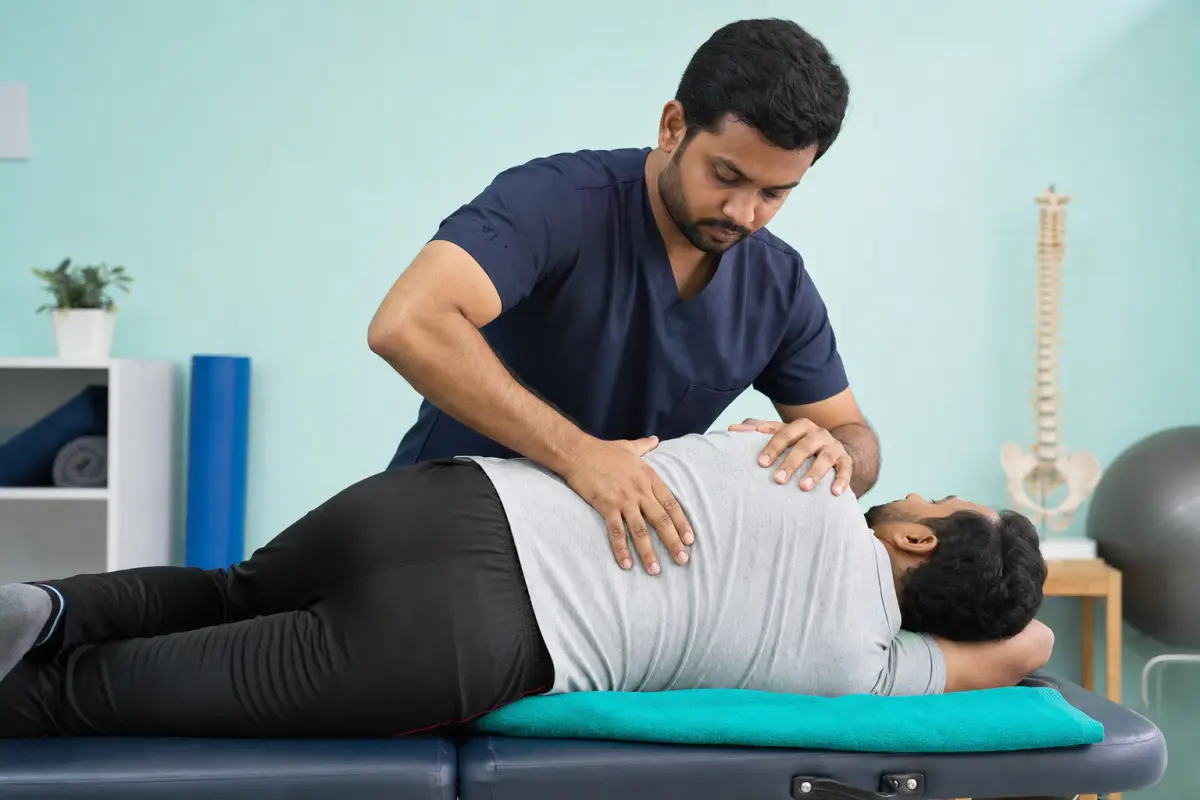
Manual therapy has a real but limited role in this. Hands-on work to a stiff segment can open a window in which movement is easier and less guarded, and I use it for that reason. It is a door-opener, not the treatment. If someone offers you a course of twelve manipulations with no exercise attached, the arithmetic does not work — the commute will still be there next month and only capacity protects you from it.
For scheduling, Andheri East addresses need the road name and a landmark rather than a pin, because the MIDC and Marol grid confuses navigation apps regularly. Evening slots after seven are the most requested and go first. Quick Physio runs home visits here rather than a clinic, which suits this presentation particularly well — the whole point is that I need to see the chair, the bag and the height of your desk, and none of those come with you to an appointment.
It contributes genuinely. Repeated vertical jolting through a seated spine is a recognised mechanical load, and the road surfaces here supply plenty of it between July and October. It is rarely the only cause, but it is often the thing that tips an already loaded back over.
If the Metro is realistic for your route, most patients find it easier on the neck and mid-back because there is no bracing against the lurch. Be aware it swaps that for longer connecting walks and more still standing, so move the bag off one shoulder either way.
For the large majority, no. Most irritated nerve roots settle over weeks with graded movement and load management. Surgery enters the conversation for progressive weakness, bladder or bowel changes, or pain that is genuinely not improving over a sustained period.
It changes the pacing more than the exercises. A shortened, lighter sleep cycle reduces the overnight window in which irritated tissue settles, so progress is usually slower and steadier. I also try to attach exercises to fixed points in your shift rather than to clock times.
For a short, painful flare it can make the first week more tolerable, and I have no objection to that. Worn all day for months it becomes a substitute for the muscles doing their job. I would rather you spend the money on nothing and raise your screen instead.
Get the screen to eye level on a stack of books, get your forearms supported on the table so the shoulders are not hanging, and put something firm behind the small of your back. Then accept that no setup survives eleven hours and stand every ninety minutes.
All three, plus the Jogeshwari and Vile Parle edges. The East side addresses take longer to find, so a road name and a nearby landmark help more than a map pin, particularly in the MIDC and Marol blocks.
Only if the assessment says a stiff segment is genuinely limiting movement, and only after the neurological screen is clear. Hands-on work buys a window where exercise is easier. Used on its own, with no loading programme behind it, it does not hold past the next commute.
Home physiotherapy
₹1600 First session ₹799
Book ₹799 home physiotherapy (metro cities) →
Clinic Google Map on Contact page →
Back pain from the Andheri commute and a long desk day? Book a home visit — first session ₹799 instead of ₹1600. Assessment at your own chair, with movement testing that finds your direction.
5
33 Google reviews
Patient reviews
Real Google reviews for Quick Physio Physiotherapy & Rehabilitation Center — 5★ from 33 patients.
I had a wonderful experience at this therapy centre. The therapists are highly professional, compassionate, and genuinely dedicated to helping their clients. The environment is clean, welcoming, and comfortable, makin…
I had a very good experience at QuickPhysio Clinic. The physiotherapists are highly skilled, professional, and take time to understand the patient’s condition properly. The treatment was effective, and I noticed signi…
Great experience overall. The staff was polite and supportive, and the treatment sessions were handled with care and attention. The exercises and guidance provided were easy to follow and really helped with recovery.
I had been suffering from slip disc and cervical pain for quite some time, and after taking physiotherapy sessions at this center, I experienced significant relief. The therapists are highly skilled, professional, and…
Excellent work by doctor. Having a great experience till 5 day.
Assessment-led care at home across Ghaziabad & Delhi NCR — first home session ₹499.
Browse locations Contact & map